
Light
Full Sun
Requires full, direct sunlight to maintain strong spine growth and shape.
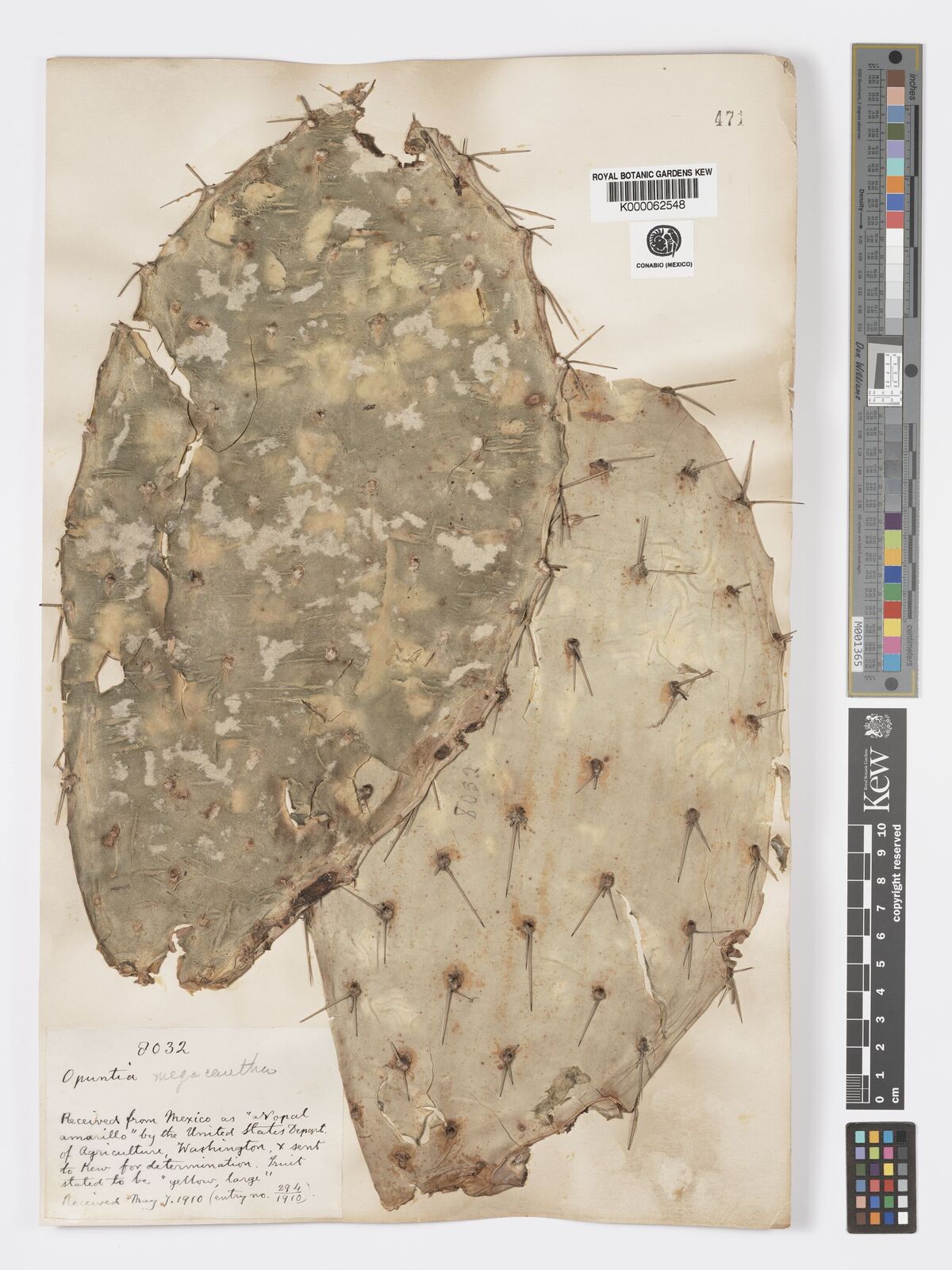 Reference image
Large-spined Prickly Pear
Opuntia megacantha, commonly known as the large-spined prickly pear, is a robust, shrubby cactus species belonging to the family Cactaceae. It is highly valued not only for its ornamental presence in xeriscapes but also for its sweet, edible fruits (tunas) and cladodes (nopalitos) 1.
This species was first formally described in 1837 by the botanist Joseph zu Salm-Reifferscheidt-Dyck. The specific epithet megacantha is derived from the Greek words mega (large) and akantha (spine), referencing the remarkably large, stout spines that arm its fleshy green segments 2.
Opuntia megacantha is native to the arid and semi-arid regions of central and northern Mexico, including states like Durango, Zacatecas, San Luis Potosí, and Jalisco 1. It thrives in desert shrublands, rocky slopes, and plains characterized by limestone-rich soils and intense sunlight 2.
This cactus exhibits a tree-like growth habit, reaching heights of 4 to 5 meters. Its flattened stem segments (cladodes) are obovate or oblong, dull green, and can grow up to 60 cm long. The areoles bear 1 to 5 stiff, yellowish-white to greyish spines up to 8 cm long, alongside small glochids. Its flowers are large, bright yellow, turning orange as they age 1.
In cultivation, it requires full sun exposure and sharp soil drainage. It is exceptionally drought-tolerant and should be watered sparingly, only when the growing medium is completely dry. While moderately cold hardy, protection from severe winter frosts is recommended to avoid scarring on the pads 2.
The most prevalent issue is overwatering, which quickly triggers root and pad rot. Insufficient sunlight leads to etiolation, wherein new pads grow thin, pale, and weak, losing their architectural shape.
Requires full, direct sunlight to maintain strong spine growth and shape.
Water only after the substrate is entirely dry; keep dry in winter.
Highly porous gravelly mix with minimal organic matter is best.
Armed with formidable spines and tiny, irritating glochids. Handle with heavy gloves.
Very easy; perfect for water-wise gardens and hands-off growers.
Naturally distributed across the high-altitude arid valleys and plains of Mexico. It is a dominant component of the local xerophytic scrub vegetation.
