
Light
Bright Indirect Light
Thrives in bright indirect light or filtered sun; avoid harsh midday direct sunlight.
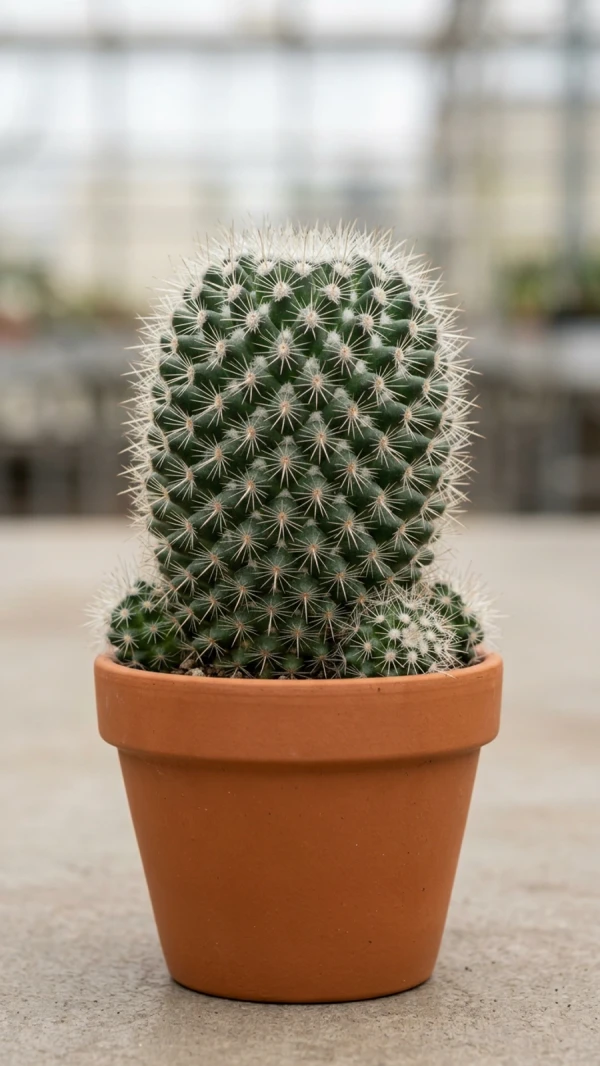
Many-Nipple Cactus
Mammillaria polythele, commonly known as the Many-Nipple Cactus, is an erect, columnar succulent subshrub belonging to the Cactaceae family. Highly valued by collectors, it is known for its prominent tubercles and early-blooming magenta flowers.
The species was formally described in 1836 1. The specific epithet 'polythele' derives from Greek, meaning 'many nipples' or 'many tubercles,' referencing the distinct rounded projections covering its stem.
This species is endemic to Mexico, with notable populations in Hidalgo, Querétaro, Guanajuato, and San Luis Potosí 2. It thrives at elevations of 1,700 to 2,400 meters above sea level, typically growing in dry shrublands, limestone slopes, and semi-arid oak forest clearings.
Mammillaria polythele features single, cylindrical stems that can reach up to 50-60 cm in height. The stem is densely covered in conical tubercles. From the areoles at the tip of these tubercles, 2 to 4 stout, slightly curved, greyish-yellow to dark brown spines emerge. During the summer, bright pink to magenta bell-shaped flowers appear in a ring near the crown of the stem.
It requires bright, indirect sunlight or filtered sun. A highly porous, mineral-based substrate containing pumice, perlite, and coarse sand is essential. Water thoroughly only when the soil has completely dried out, and keep the plant dry and cool during winter dormancy.
Overwatering is the primary cause of failure, quickly leading to root and stem rot 2. Inadequate light causes etiolation, where the stem becomes pale, weak, and unnaturally stretched.
Thrives in bright indirect light or filtered sun; avoid harsh midday direct sunlight.
Water only when the substrate is completely dry. Keep almost dry in winter.
Use a well-draining cactus mix high in pumice and coarse grit.
Non-toxic to pets, but features sharp spines that can cause physical injury.
Very easy to care for, provided it is not overwatered.
Native to the high-elevation arid shrublands and limestone slopes of central Mexico.
