Species

Maihueniopsis hickenii

Maihueniopsis hickenii

Maihueniopsis hickenii

Maihueniopsis hickenii (Britton & Rose) D.R.Hunt is treated as an accepted taxon in Plants of the World Online.1

The current source-backed classification places it in Cactaceae within Maihueniopsis.12

Its recorded native range/source remark is AGEER, AGSNE, AGWSE, AGE, AGSRN, AGWCA, AGWSA, AGSCB, AGEMI, AGESF, AGSTF, AGS; Argentina.1

POWO records the plant context as succulent subshrub, temperate.1

This is a source-populated draft intended for later Kaktus Doktoru editorial rewriting; care advice and morphology should be reviewed before publication.

References

  1. Plants of the World Online. "Maihueniopsis hickenii (Britton & Rose) D.R.Hunt". Royal Botanic Gardens, Kew. Accessed: 2026-06-10. https://powo.science.kew.org/taxon/urn:lsid:ipni.org:names:77115302-1
  2. GBIF Secretariat. "Maihueniopsis hickenii". GBIF Backbone Taxonomy. Accessed: 2026-06-10. https://www.gbif.org/species/8237955

Plants In This Group

Maihueniopsis hickenii

Maihueniopsis hickenii

Maihueniopsis hickenii

Maihueniopsis hickenii is a cushion-forming, low-growing succulent shrub belonging to the Cactaceae family, highly adapted to the harsh conditions of Patagonia 1. It is known for its remarkable cold tolerance and compact growth habit.

Classification and naming

The species belongs to the genus Maihueniopsis. The specific epithet \"hickenii\" honors the prominent Argentine botanist Cristóbal María Hicken. It has historically been classified under Opuntia due to its segmented growth, but phylogenetic studies place it firmly within Maihueniopsis 2.

Distribution and habitat

This species is native to southern Argentina, particularly in the Patagonian provinces of Santa Cruz, Chubut, and Río Negro 1. It thrives in arid, wind-swept gravelly plains and rocky slopes at moderate to high elevations, enduring extreme temperature fluctuations.

Appearance

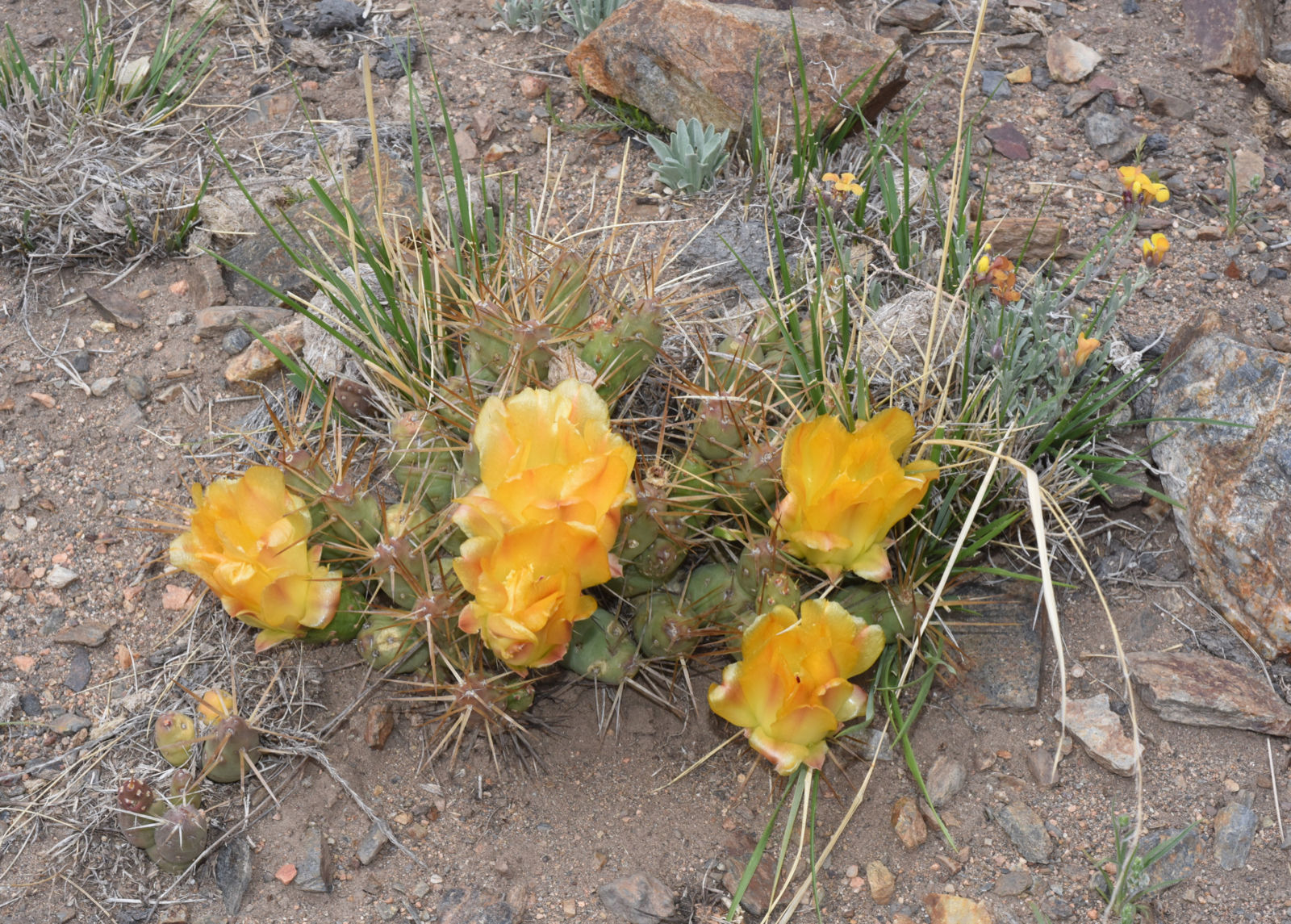
It forms dense, flat cushions composed of small, egg-shaped to cylindrical segments. The segments are dull greyish-green, bearing prominent areoles with sturdy, yellowish-brown, flattened spines. In late spring or summer, it produces beautiful, bright yellow cup-shaped flowers at the branch tips.

Cultivation and care

In cultivation, Maihueniopsis hickenii requires full sun and exceptionally well-drained, mineral-rich soil 2. Given its Patagonian origin, it is extremely cold-hardy, tolerating temperatures down to -15°C, provided the substrate is kept entirely dry during the winter resting period. Watering should be deep but infrequent in summer.

Common cultivation mistakes

The most common pitfall is overwatering, especially during winter. A combination of cold temperatures and wet soil quickly leads to root and stem rot. Insufficient sunlight will cause weak, elongated growth.

References

  1. Plants of the World Online (POWO). \"Maihueniopsis hickenii\". Kew Science.
  2. Anderson, E. F. (2001). \"The Cactus Family\". Timber Press.

Frequently Asked Questions

What is Maihueniopsis hickenii?
Maihueniopsis hickenii is a species-level taxonomy entry identified by the scientific name Maihueniopsis hickenii.
Which rank is Maihueniopsis hickenii?
Maihueniopsis hickenii is shown as a species in our botanical dictionary.
Which groups sit below Maihueniopsis hickenii?
No lower taxonomy landing pages are currently shown for Maihueniopsis hickenii.
Are there plants related to Maihueniopsis hickenii?
Yes. Related dictionary entries include Maihueniopsis hickenii.
Is this taxonomy page a care guide?
No. This page explains scientific classification; light, watering, and safety guidance belongs on individual plant pages.
Is Maihueniopsis hickenii a product category?
No. This is a scientific taxonomy record. Product categories are organized separately around customer search intent.
Why is the Latin name shown?
The Latin scientific name reduces ambiguity between common names across languages and regions.
Where can I see the parent ranks?
The taxonomy card shows the parent ranks of Maihueniopsis hickenii inside the scientific hierarchy.
Can this page change over time?
Yes. Taxonomy and dictionary content can be updated as botanical data, greenhouse observations, and collection records improve.
Why is this different from a plant detail page?
This page explains a classification node. Individual plant pages contain care notes, collection links, and practical growing information.