
Ariocarpus bravoanus

Bravo's Living Rock Cactus

Overview

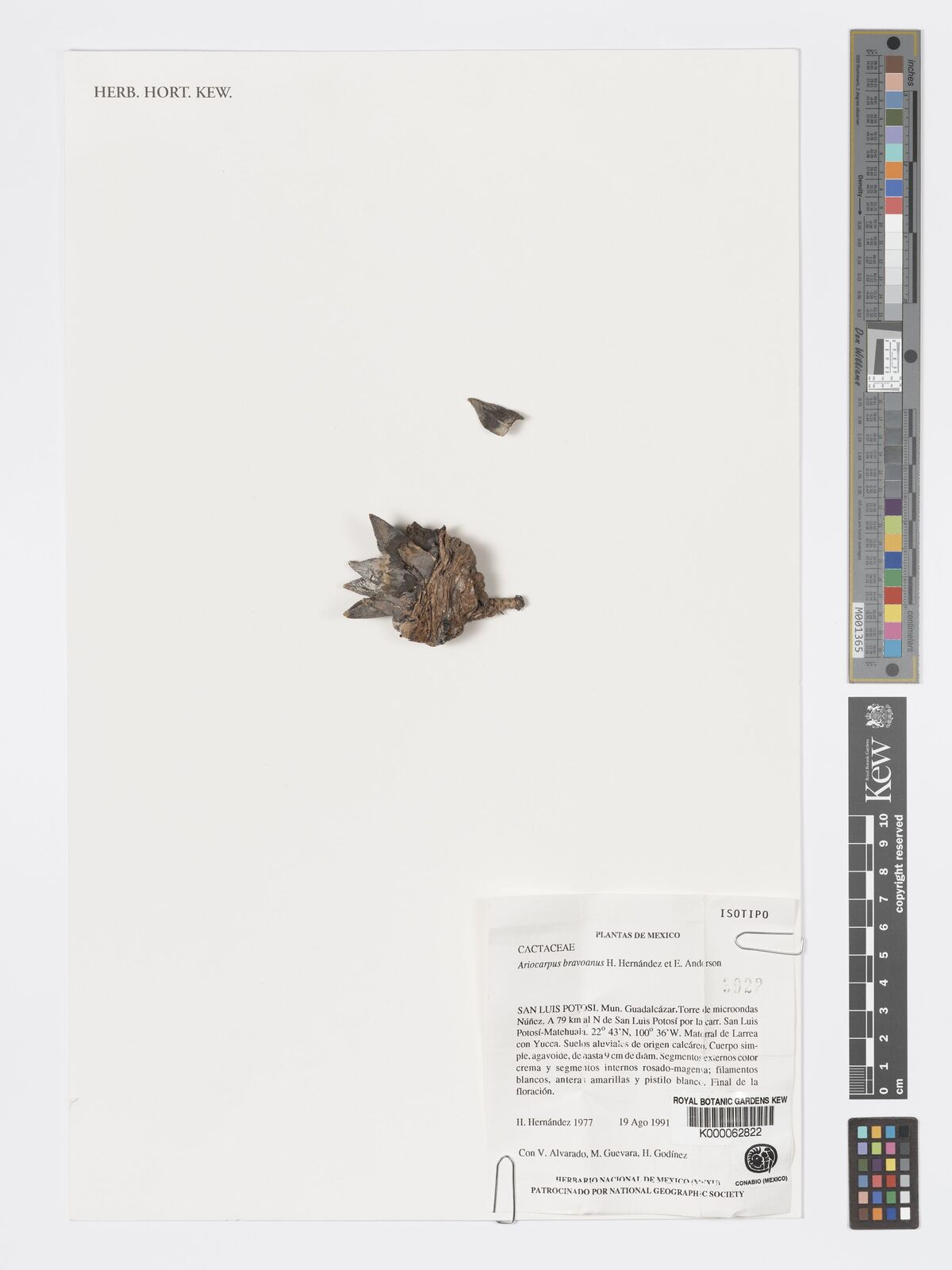
Ariocarpus bravoanus is an extremely slow-growing, highly prized geophytic cactus known for its unique rosette shape. In habitat, it grows flush with the ground, making it difficult to spot 1.

Taxonomy and naming

Belonging to the genus Ariocarpus, this species was described in 1992 and named in honor of the prominent Mexican botanist Helia Bravo-Hollis 1.

Distribution and habitat

Endemic to a very restricted area in San Luis Potosí, Mexico, it grows on limestone gravel slopes and plains within dry desert scrub ecosystems 2.

Appearance

The plant has a flattened, greyish-green subglobose stem with triangular, fissured tubercles. Central areoles are woolly, and vivid pink to magenta flowers emerge from the crown in autumn 1.

Cultivation and care

This species is highly sensitive to excess moisture due to its large taproot. Cultivation requires a highly porous, purely mineral substrate and careful watering restricted to the active growing season.

Common care mistakes$

Overwatering during the winter rest period or using standard peat-based potting soils will invariably lead to root rot and loss of the plant 2.

References

  1. Anderson, E. F. (2001). The Cactus Family. Timber Press.
  2. Fitz Maurice, B & Fitz Maurice, W.A. (2013). Ariocarpus bravoanus. IUCN Red List.
Light

Filtered Sun

Requires bright, filtered sunlight; protect from intense, direct midday summer sun.
Watering

14-45 Days

Water minimally during summer only when the substrate is bone dry. Keep completely dry in winter.

Soil

Highly porous, mineral-rich substrate containing pumice, limestone grit, and minimal organic matter.

Must be planted in a fast-draining mineral mix consisting of pumice, lava rock, and limestone grit.

Safety

Contact/Ingestion Risk

Lacks sharp spines but contains toxic alkaloids; keep away from pets and children.

Difficulty

Expert

Highly prone to rot and exceptionally slow-growing; best suited for expert collectors.

Native Habitat

Mexico (San Luis Potosí)

Restricted to limestone formations and gravelly soils in the semi-arid desert regions of San Luis Potosí, Mexico, where it blends seamlessly with the surrounding rocks.

Frequently Asked Questions

How often should Ariocarpus bravoanus be watered?
Water only during spring and summer when the soil is bone dry. Cease watering entirely during winter.
What is the best soil mix?
It requires a purely mineral mix with little to no organic material, using pumice, lava rock, and limestone grit.
Is it toxic to pets?
It does not have sharp spines but contains alkaloids, making it mildly toxic. Keep it out of reach of pets.
How fast does it grow?
It is extremely slow-growing. Growing from seed to flowering size can take anywhere from 8 to 12 years.
What kind of pot should I use?
Deep clay or terracotta pots with drainage holes are preferred to accommodate its thick taproot system.
When does it bloom?
It typically blooms in autumn (between September and November), producing pink-magenta flowers from the crown.
What are its light requirements?
It needs plenty of bright, filtered sunlight. Protect it from scorching direct midday summer sun.
What is the minimum winter temperature?
If kept completely dry, it can survive brief drops to 5°C (41°F), but it must be protected from frost.
Why is it softening or shrinking?
Slight shrinking in winter is normal. If it softens during the growing season, it is likely root rot caused by overwatering.
Is it difficult to grow from seed?
Yes, while germination is relatively easy, keeping the tiny, slow-growing seedlings alive requires great care and patience.