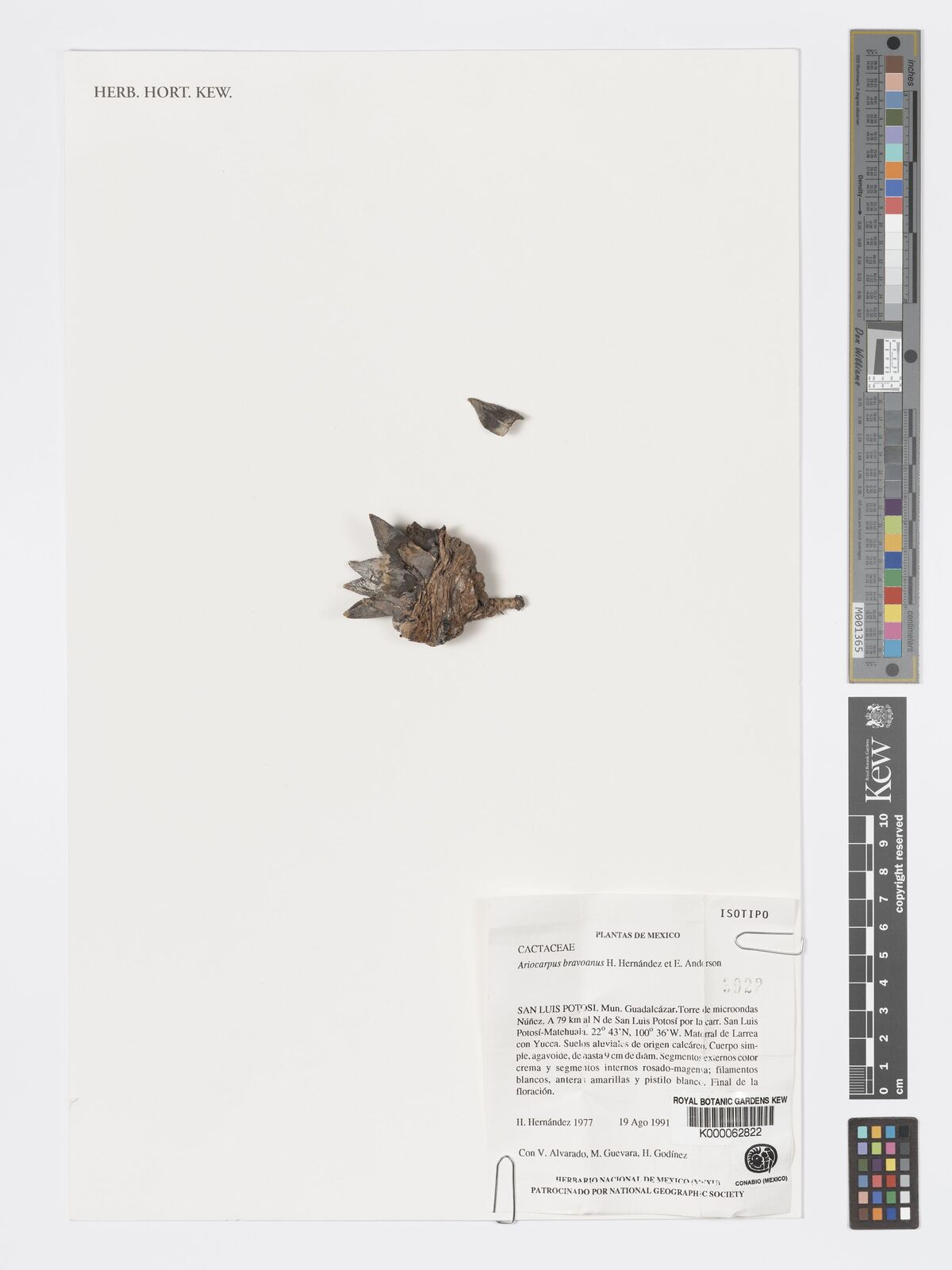
Species

Ariocarpus bravoanus

Ariocarpus bravoanus

Ariocarpus bravoanus

Ariocarpus bravoanus H.M.Hern. & E.F.Anderson is treated as an accepted taxon in Plants of the World Online.1

The current source-backed classification places it in Cactaceae within Ariocarpus.12

Its recorded native range/source remark is MXEAG, MXECU, MXEHI, MXEZA, MXEQU, MXEGU, MXESL, MXEDU, NORTHERNAMERICA, MEXICO, MXE, MXETA; Mexico (San Luis Potosí).1

POWO records the plant context as succulent subshrub, desert or dry shrubland.1

This is a source-populated draft intended for later Kaktus Doktoru editorial rewriting; care advice and morphology should be reviewed before publication.

References

  1. Plants of the World Online. "Ariocarpus bravoanus H.M.Hern. & E.F.Anderson". Royal Botanic Gardens, Kew. Accessed: 2026-06-10. https://powo.science.kew.org/taxon/urn:lsid:ipni.org:names:301152-2
  2. GBIF Secretariat. "Ariocarpus bravoanus". GBIF Backbone Taxonomy. Accessed: 2026-06-10. https://www.gbif.org/species/7283159

Plants In This Group

Ariocarpus bravoanus

Ariocarpus bravoanus

Ariocarpus bravoanus

Ariocarpus bravoanus is an extremely slow-growing, highly prized geophytic cactus known for its unique rosette shape. In habitat, it grows flush with the ground, making it difficult to spot 1.

Taxonomy and naming

Belonging to the genus Ariocarpus, this species was described in 1992 and named in honor of the prominent Mexican botanist Helia Bravo-Hollis 1.

Distribution and habitat

Endemic to a very restricted area in San Luis Potosí, Mexico, it grows on limestone gravel slopes and plains within dry desert scrub ecosystems 2.

Appearance

The plant has a flattened, greyish-green subglobose stem with triangular, fissured tubercles. Central areoles are woolly, and vivid pink to magenta flowers emerge from the crown in autumn 1.

Cultivation and care

This species is highly sensitive to excess moisture due to its large taproot. Cultivation requires a highly porous, purely mineral substrate and careful watering restricted to the active growing season.

Common care mistakes$

Overwatering during the winter rest period or using standard peat-based potting soils will invariably lead to root rot and loss of the plant 2.

References

  1. Anderson, E. F. (2001). The Cactus Family. Timber Press.
  2. Fitz Maurice, B & Fitz Maurice, W.A. (2013). Ariocarpus bravoanus. IUCN Red List.

Frequently Asked Questions

What is Ariocarpus bravoanus?
Ariocarpus bravoanus is a species-level taxonomy entry identified by the scientific name Ariocarpus bravoanus.
Which rank is Ariocarpus bravoanus?
Ariocarpus bravoanus is shown as a species in our botanical dictionary.
Which groups sit below Ariocarpus bravoanus?
No lower taxonomy landing pages are currently shown for Ariocarpus bravoanus.
Are there plants related to Ariocarpus bravoanus?
Yes. Related dictionary entries include Ariocarpus bravoanus.
Is this taxonomy page a care guide?
No. This page explains scientific classification; light, watering, and safety guidance belongs on individual plant pages.
Is Ariocarpus bravoanus a product category?
No. This is a scientific taxonomy record. Product categories are organized separately around customer search intent.
Why is the Latin name shown?
The Latin scientific name reduces ambiguity between common names across languages and regions.
Where can I see the parent ranks?
The taxonomy card shows the parent ranks of Ariocarpus bravoanus inside the scientific hierarchy.
Can this page change over time?
Yes. Taxonomy and dictionary content can be updated as botanical data, greenhouse observations, and collection records improve.
Why is this different from a plant detail page?
This page explains a classification node. Individual plant pages contain care notes, collection links, and practical growing information.