
Astrophytum myriostigma

Bishop's Cap Cactus

Astrophytum myriostigma: The Bishop's Cap Cactus

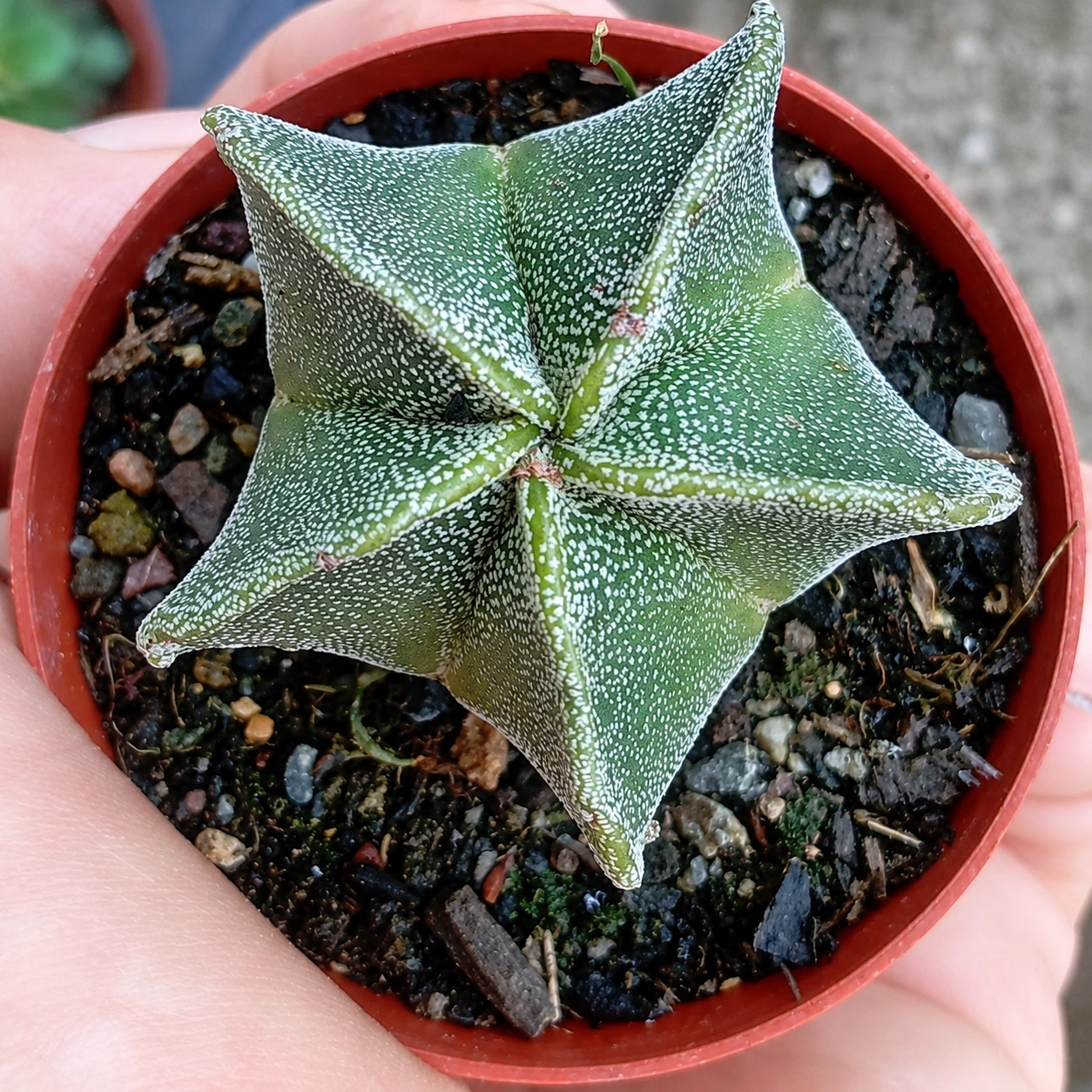
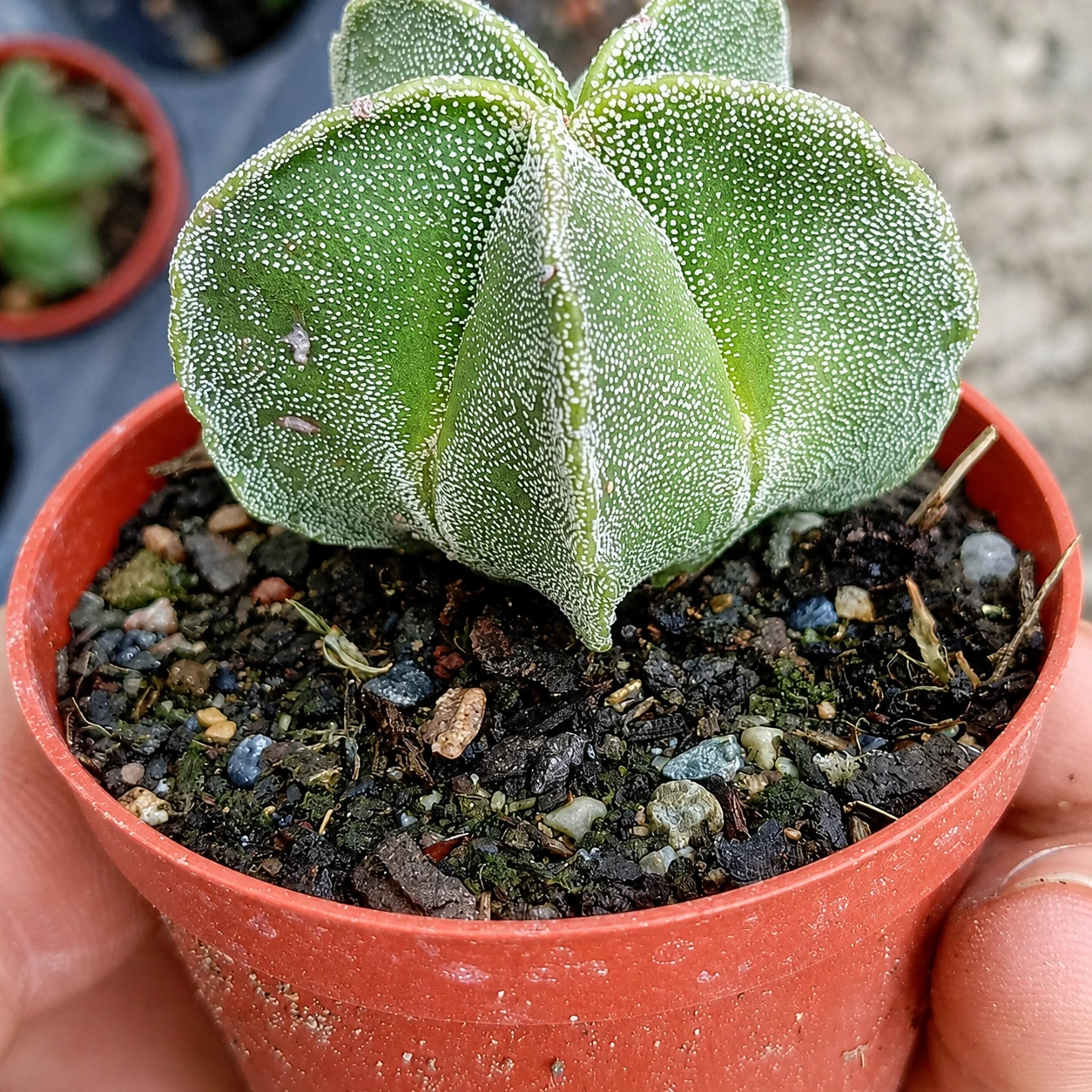
Astrophytum myriostigma is a highly ornamental, spineless cactus species belonging to the Cactaceae family. It is commonly known as "Bishop's Cap Cactus" or "Bishop's Hat Cactus." Its name, derived from Greek "astro" (star) and "phyton" (plant), refers to the distinctive star-shaped appearance of the plant's crown 1. This species is typically characterized by five prominent vertical ribs, which give it its unique star-like or miter-like shape. Some varieties may feature four or more ribs.

Morphology and Growth

A. myriostigma features a globular, spherical stem that can become more cylindrical with age. The plant's surface is covered with tiny, woolly flecks (trichomes) that give it a whitish, mossy appearance. These trichomes help protect the plant from sun scorch and retain moisture in its natural arid habitat. These spots may be more pronounced in younger plants. Mature specimens can reach up to 25 cm (10 inches) in height and 10-20 cm (4-8 inches) in width. Its spineless nature distinguishes it from many other cactus species, making it a popular choice for indoor cultivation.

Flowering and Habitat

During the summer months or late spring, A. myriostigma produces bright yellow flowers, sometimes with a reddish center, from its apex. These flowers typically open during the day and remain vibrant for several days. Native to the semi-desert regions of northeastern and central Mexico, A. myriostigma naturally thrives in calcareous, well-drained soils. It is listed as "Least Concern" on the IUCN Red List, though illegal collection and habitat loss may affect some local populations 2.

References

  1. Anderson, Edward F. (2001). The Cactus Family. Timber Press.
  2. IUCN Red List of Threatened Species. Astrophytum myriostigma. Available at: https://www.iucnredlist.org/species/152865/456860
Light

Filtered Sun

Prefers bright, filtered light. Intense midday sun, especially in summer, can cause sunburn, so protect it from direct exposure.
Watering

10-30 Days

Water generously only after the soil has completely dried out. During winter (dormancy), cease watering or provide very minimal amounts once a month.

Soil

Well-draining, gritty cactus mix

Use a sandy, very well-draining soil mix specifically formulated for cacti and succulents. Ensure the pot has adequate drainage holes.

Safety

Pet Friendly

Astrophytum myriostigma is a spineless cactus and is not known to be toxic to humans or pets. It can be grown safely in homes.

Difficulty

Moderate

This cactus has a moderate care level. It is quite resilient when provided with the correct light, watering, and soil conditions. Suitable for beginners in cactus care.

Native Habitat

Mexico (Northeastern and Central Mexico)

The Bishop's Cap Cactus is indigenous to the extensive semi-arid regions of Mexico, primarily found in the states of Coahuila, Nuevo León, San Luis Potosí, Tamaulipas, Hidalgo, Querétaro, Aguascalientes, Guanajuato, and Durango. It prefers the calcareous soils and arid climate of these areas. It is often found growing in partial shade beneath shrubs or rocks.

Frequently Asked Questions

What is the best pot for Astrophytum myriostigma and when should it be repotted?
An **aerated pot with good drainage**, such as terracotta, is ideal for Astrophytum myriostigma. Repotting should generally be done in spring every 2-3 years, or when the plant outgrows its current pot. Be careful not to disturb the root system.
How often should the Bishop's Cap Cactus be watered?
During summer, water thoroughly after the soil has completely dried out (approximately every 10-14 days). In winter, when the plant enters dormancy, you should stop watering or provide very limited amounts (a few drops once a month).
What type of light does this cactus prefer?
*Astrophytum myriostigma* prefers **bright, filtered light**. Direct midday sun, especially in summer, can cause sunburn on the plant. An east or west-facing window is ideal.
What is the most suitable soil mix for Astrophytum myriostigma?
You should use an **aerated and very well-draining** cactus and succulent soil mix. You can enhance drainage by adding perlite, pumice, or coarse sand to a ready-made cactus soil.
When and how does the Bishop's Cap Cactus bloom?
It typically blooms during the warmer months, such as late spring and early summer. It produces **bright yellow, sometimes red-centered** flowers from its apex. Good light and a cool winter dormancy period are crucial to encourage flowering.
What is the growth rate of Astrophytum myriostigma?
This cactus is a **slow-growing** species. It only grows a few centimeters annually and can take several years to reach its mature size. However, this slow growth makes it more manageable for indoor spaces.
What kind of winter care does the Bishop's Cap Cactus need?
In winter, it enters a **dormancy period**. Almost completely cease watering and keep the plant in a cool (ideally between 5-10°C) but frost-free environment. This period is crucial for flowering in spring.
How can I propagate Astrophytum myriostigma?
It is usually propagated by **seeds**. Seeds germinate in well-drained, moist soil in a warm environment. Although side shoots are rare, if present, they can be carefully separated for propagation.
Is Astrophytum myriostigma toxic to pets?
No, *Astrophytum myriostigma* is **not toxic to pets**. Since it is also spineless, it can be safely grown in environments with pets.
Why do the ribs of the Bishop's Cap Cactus sometimes vary in number?
Although it typically has five ribs, varieties with four or more ribs can be found. This condition is due to the plant's genetic makeup, and sometimes environmental factors can also play a role. These variations create rare and sought-after forms of the cactus.