
Light
Full Sun
A very bright position with gradually introduced direct sun supports compact growth; bluish epidermis is not an automatic guarantee against scorch.
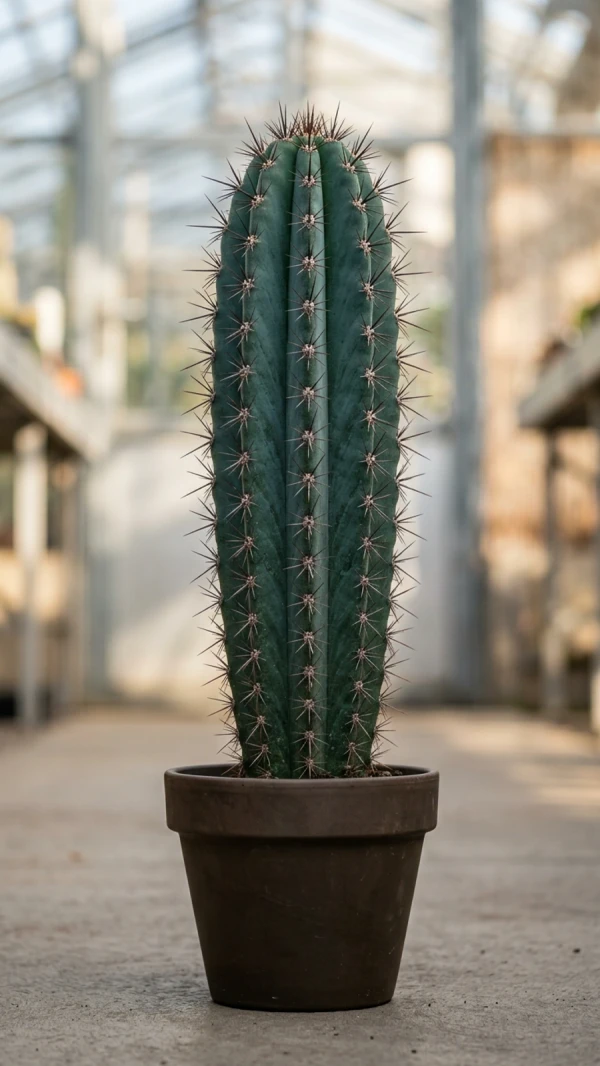
Black Cereus
Cereus aethiops is a natural columnar cactus from Uruguay across northern and southern Argentina, noted for variable bluish-dark stems and dark spination. The species belongs to a southern-cone Cereus complex associated with bluish-green to dark epidermis, pronounced ribs, and dark spines. Historical names such as “azureus”, “coerulescens”, “melanacanthus”, and “nigrispinus” sharing one synonym surface show that stem blueness or spine darkness alone does not define the species. Unlike the taxonomy article, the botanical-dictionary layer explains the living plant's morphology, habitat context, and cultivation requirements.
The verified native range is Uruguay and north-eastern, north-western, and southern Argentina.1 POWO records the species across subtropical Uruguay and a broad north-to-south Argentine range. Population variation in temperature, rainfall, stem colour, and spination should therefore be expected rather than compressed into one “black” or “blue” retail label. Cultivation should not imitate a landscape as decoration; it should provide fast oxygen return to the root zone, a controlled wet-dry cycle, and strong light.
A very bright position with gradually introduced direct sun supports compact growth; bluish epidermis is not an automatic guarantee against scorch. A tall plant raised under lower light should not be moved abruptly into harsh sun; increase exposure over several weeks. Wet roots during cool weather are generally more dangerous than controlled dry coolness.
Do not use a fixed-day calendar. During active growth, water thoroughly only after the mix has dried throughout and let every excess drain away. Drying slows during cool or low-light periods, so watering naturally becomes less frequent. Use a coarse, mineral-forward, airy, fast-draining mix and verify that moisture does not persist inside a large root ball during cool periods.
Retail names such as “black Cereus” or “blue Cereus” may describe stem and spine colour but are not scientific equivalents of the broad 17-synonym species concept. Ribs, areoles, flowers, fruit, and provenance must be assessed together. Stem colour, branching, spine density, and flowering time vary among living specimens; a product photograph alone is neither a scientific diagnosis nor a record of a wild population.
The best-supported household concern is mechanical injury from the spines rather than a claim of chemical toxicity. Tall columnar plants also require protection against tipping and weight-related injury. The IUCN layer exposed through WFO reports Least Concern. That category applies to the broad species concept and does not imply that local habitat loss, population differences, or collection pressure are absent.
A very bright position with gradually introduced direct sun supports compact growth; bluish epidermis is not an automatic guarantee against scorch.
Do not use a fixed calendar. Water deeply after complete drying and reduce frequency during cool or low-light periods.
A coarse, mineral-forward, airy cactus mix that dries rapidly during cool periods.
Spines present a mechanical injury risk. The IUCN layer exposed through WFO reports Least Concern. That category applies to the broad species concept and does not imply that local habitat loss, population differences, or collection pressure are absent.
It is manageable with fast drainage; hidden cool-season moisture, abrupt harsh sun, and treating a retail colour label as a species diagnosis are the main risks.
Uruguay and north-eastern, north-western, and southern Argentina.[^1] [^1]: Plants of the World Online. “Cereus aethiops.” Accessed: 2026-08-04. https://powo.science.kew.org/taxon/urn:lsid:ipni.org:names:52722-2
