
Light
Direct Sun
Requires at least 6 hours of direct sunlight daily; ideal for south- or west-facing windows.
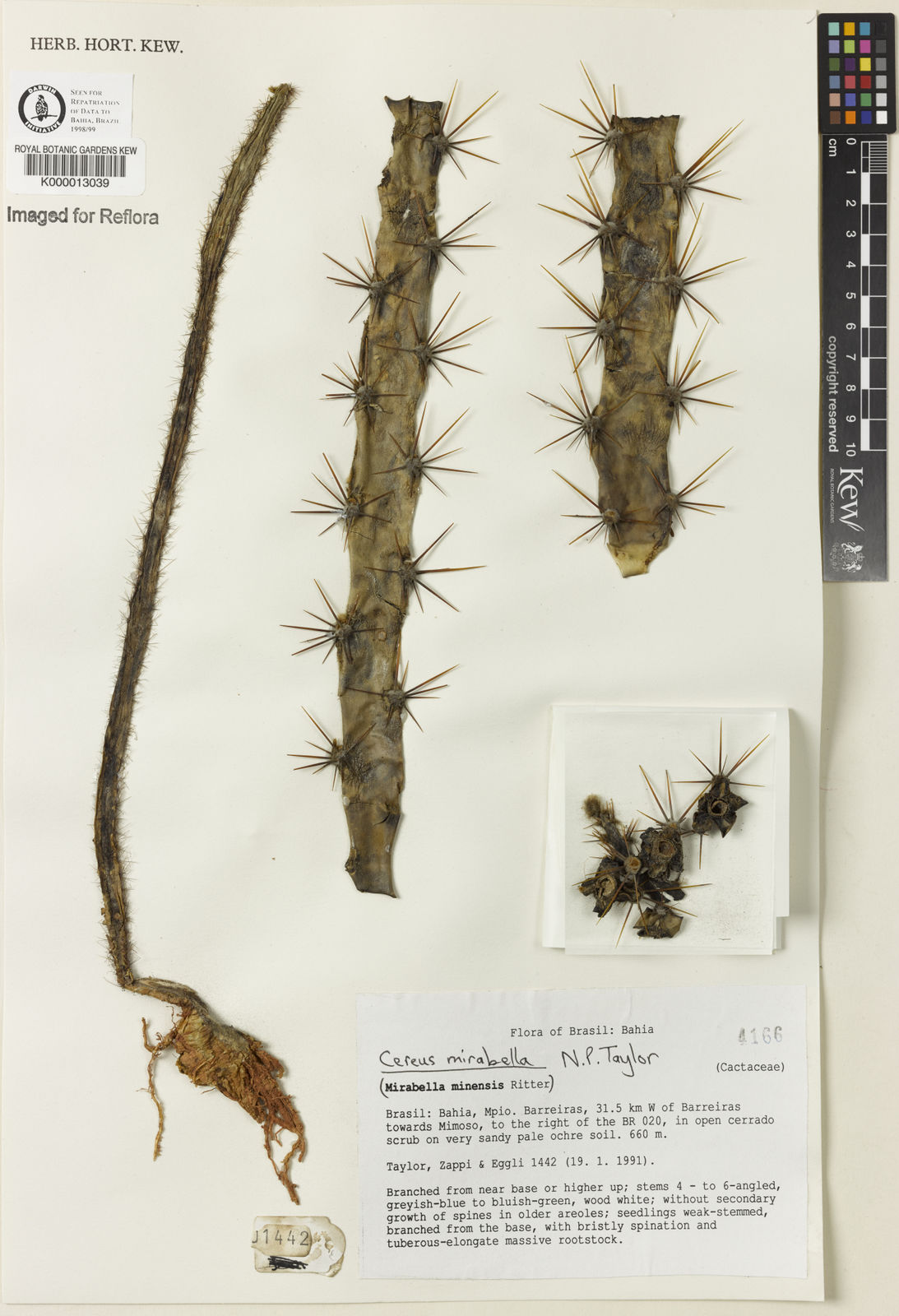 Reference image
Mirabella Cactus
Cereus mirabella is a distinct, slender-stemmed, semi-scandent cactus species native to the arid regions of Brazil 1. Unlike typical massive columnar cacti, it exhibits a more delicate, sprawling, and branching growth habit.
Classified under the genus Cereus in the family Cactaceae, this species is also known under the synonym Mirabella minensis 2. The specific epithet 'mirabella' derives from the Latin word for 'wonderful' or 'beautiful'.
Native to Minas Gerais and Bahia in Brazil, it thrives in the seasonally dry tropical forests of the Caatinga biome 1. It typically grows on rocky outcrops and sandy flats alongside deciduous scrub vegetation.
It features slender, blue-green stems with 3 to 6 prominent ribs. The small areoles bear short, needle-like spines and light gray wool. It produces nocturnal, funnel-shaped white flowers that open for just one night.
Highly tolerant of direct sun and high temperatures, it grows rapidly in porous, mineral-rich soils during summer. In winter, temperatures should not drop below 8°C, and the substrate must remain dry 2.
Overwatering during the winter dormancy period is the most common cause of root rot. Insufficient sunlight leads to etiolation, causing the slender stems to weaken and lose their attractive coloration.
Requires at least 6 hours of direct sunlight daily; ideal for south- or west-facing windows.
Allow soil to dry out completely between waterings; keep almost completely dry in winter.
Use a mineral-heavy mix containing pumice, gravel, and minimal organic matter.
Non-toxic to pets, but has sharp, needle-like spines. Keep away from curious animals and children.
Moderate difficulty; key success factors are preventing winter rot and ensuring adequate sun.
Native to the seasonally dry tropical forests, rocky fields, and scrubby woodlands of northeastern, central, and southeastern Brazil, particularly within the Bahia and Minas Gerais regions.
