
Cereus mirabella
Cereus mirabella
Cereus mirabella
Cereus mirabella N.P.Taylor is treated as an accepted taxon in Plants of the World Online.1
The current source-backed classification places it in Cactaceae within Cereus.12
Its recorded native range/source remark is BZCMT, BZEFN, BZNRO, BZNTO, BZNAC, BZEPE, BZLMG, BZECE, BZEBA, BZC, BZLRJ, BZC_GO; Brazil.1
POWO records the plant context as succulent tree, seasonally dry tropical.1
This is a source-populated draft intended for later Kaktus Doktoru editorial rewriting; care advice and morphology should be reviewed before publication.
References
- Plants of the World Online. "Cereus mirabella N.P.Taylor". Royal Botanic Gardens, Kew. Accessed: 2026-06-10. https://powo.science.kew.org/taxon/urn:lsid:ipni.org:names:968031-1 ↩
- GBIF Secretariat. "Cereus mirabella". GBIF Backbone Taxonomy. Accessed: 2026-06-10. https://www.gbif.org/species/5622772 ↩
Plants In This Group
Cereus mirabella
Cereus mirabella
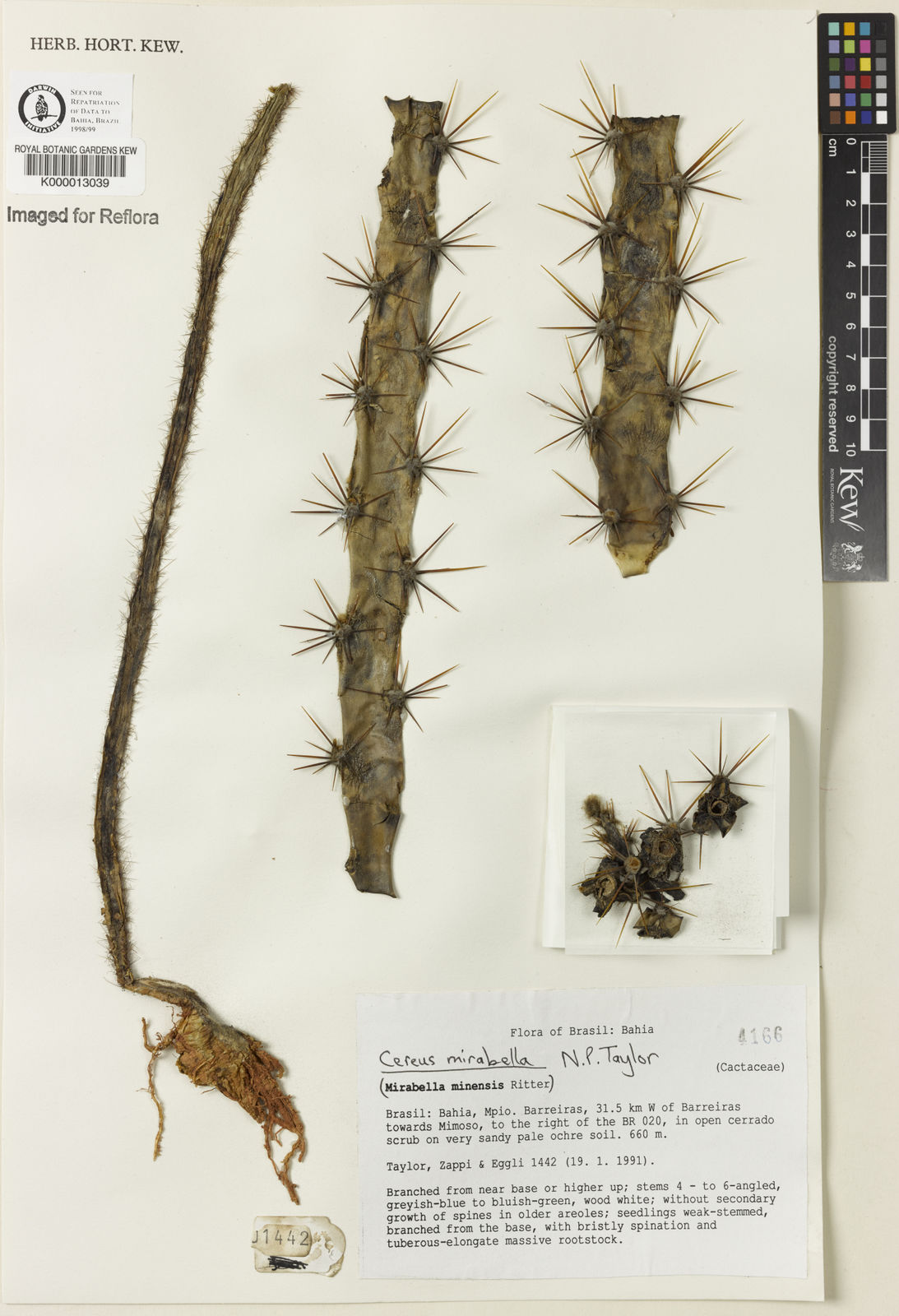
Cereus mirabella is a distinct, slender-stemmed, semi-scandent cactus species native to the arid regions of Brazil 1. Unlike typical massive columnar cacti, it exhibits a more delicate, sprawling, and branching growth habit.
Taxonomy and Naming
Classified under the genus Cereus in the family Cactaceae, this species is also known under the synonym Mirabella minensis 2. The specific epithet 'mirabella' derives from the Latin word for 'wonderful' or 'beautiful'.
Distribution and Habitat
Native to Minas Gerais and Bahia in Brazil, it thrives in the seasonally dry tropical forests of the Caatinga biome 1. It typically grows on rocky outcrops and sandy flats alongside deciduous scrub vegetation.
Appearance
It features slender, blue-green stems with 3 to 6 prominent ribs. The small areoles bear short, needle-like spines and light gray wool. It produces nocturnal, funnel-shaped white flowers that open for just one night.
Cultivation and Care
Highly tolerant of direct sun and high temperatures, it grows rapidly in porous, mineral-rich soils during summer. In winter, temperatures should not drop below 8°C, and the substrate must remain dry 2.
Common Cultivation Mistakes
Overwatering during the winter dormancy period is the most common cause of root rot. Insufficient sunlight leads to etiolation, causing the slender stems to weaken and lose their attractive coloration.