
Light
Bright Indirect Light
Requires bright, filtered sunlight. Insufficient light leads to etiolation and loss of its distinct dark skin color.
 Reference image
Esmeralda Cactus
Eriosyce esmeraldana is a highly sought-after, miniature cactus species endemic to the extremely arid coastal regions of northern Chile 1. It is well-regarded among collectors for its dark, globose stem and substantial underground taproot.
Originally described under the genus Chileorebutia as Chileorebutia esmeraldana, it was later integrated into the diverse genus Eriosyce following modern phylogenetic analyses 2. The genus name Eriosyce translates to 'woolly fig', referencing the woolly fruits, while the specific epithet esmeraldana honors the coastal locality of Esmeralda, Chile.
This succulent subshrub is native to the coastal deserts of Atacama and Antofagasta in Chile 1. It thrives in gravelly slopes, rock crevices, and sandy pockets where rainfall is virtually non-existent. Survival is largely supported by condensation from the dense coastal fog known locally as 'camanchaca'.
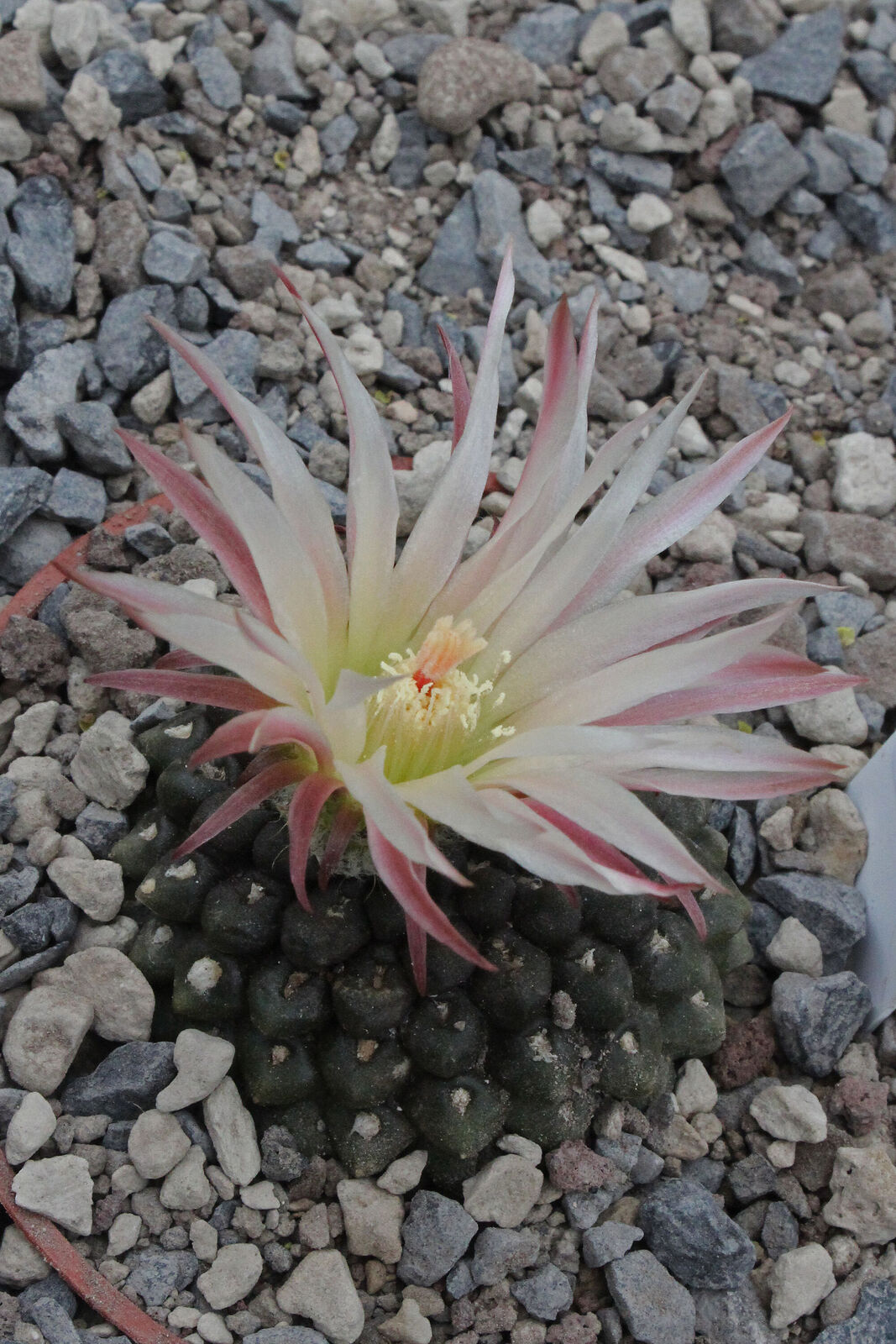
The stem is solitary, subglobose to flattened, exhibiting a dark brownish-green to purplish hue, reaching up to 4-5 cm in diameter. Beneath the soil, it develops a massive, tuberous taproot that serves as a water reservoir. The flowers arise from the woolly apex, displaying shades of pale yellow, cream, or light pink with darker midribs.
In cultivation, Eriosyce esmeraldana requires exceptional drainage, as it is highly susceptible to root rot. It demands a highly mineral, gritty substrate with minimal organic components. Watering should be sparse during the active summer growth and suspended during winter. Bright indirect light is essential for maintaining its compact habit and dark coloration.
The most frequent pitfall is overwatering, combined with heavy, water-retaining soils. This quickly rots the sensitive taproot 2. Water applications during low-temperature periods or high humidity can also prove fatal.
Requires bright, filtered sunlight. Insufficient light leads to etiolation and loss of its distinct dark skin color.
Water only when the medium is completely dry. Keep strictly dry and cool during winter dormancy.
Requires an extremely porous mineral mix consisting of pumice, lava rock, and coarse sand.
Non-toxic to cats, dogs, and humans, but sharp radials require careful handling.
Moderately difficult due to high sensitivity of the taproot to overwatering and stagnant moisture.
Native to the hyper-arid coastal cliffs of northern Chile. It survives in barren, rocky terrains where moisture is gathered primarily from dense sea fogs blowing in from the Pacific Ocean.
