
Light
Full Sun
Requires at least 6 hours of direct, unfiltered sunlight daily to maintain its rich spine color and stout shape.
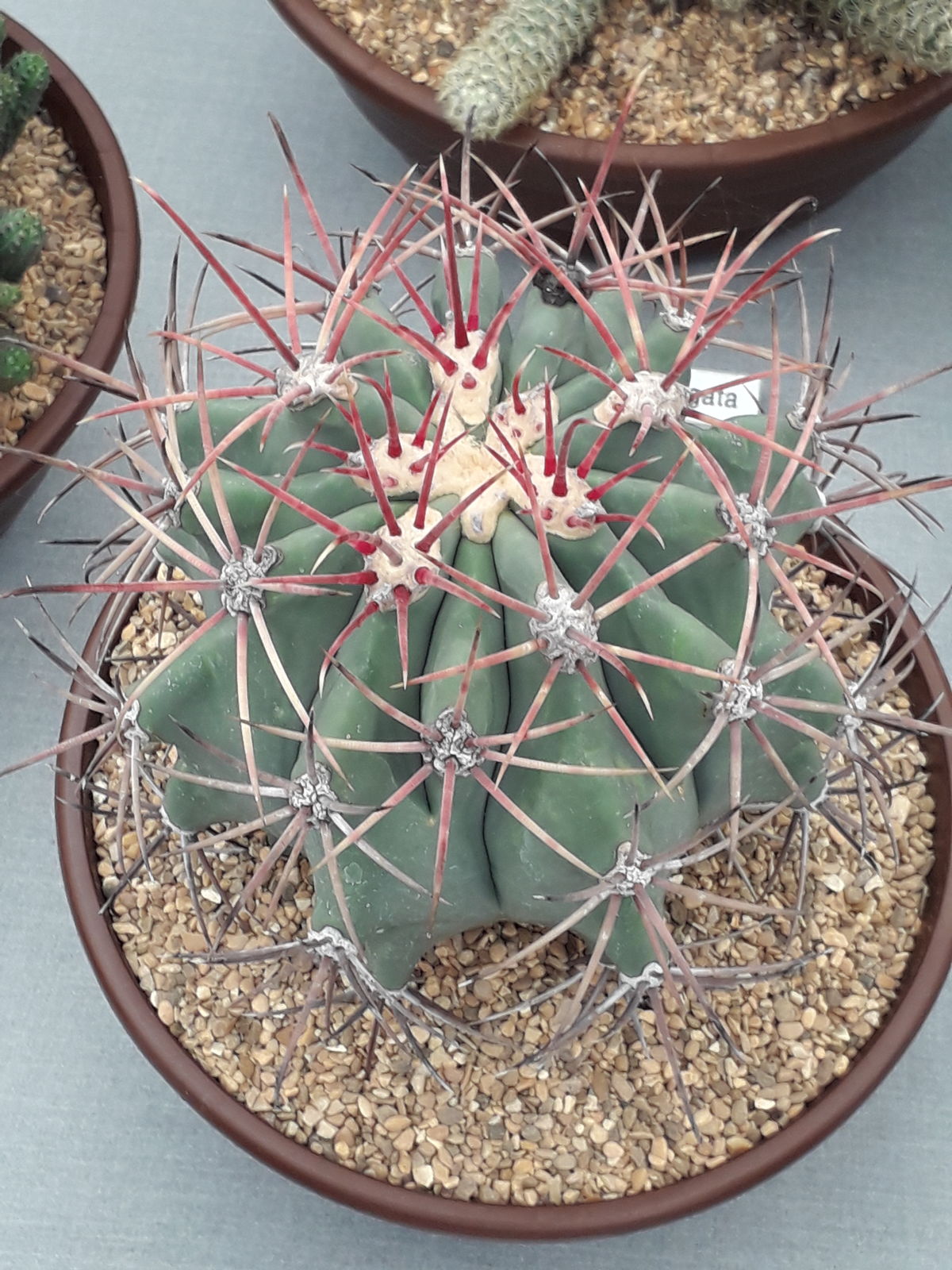 Reference image
Emory's Barrel Cactus
Ferocactus emoryi, commonly known as Emory's barrel cactus, is an iconic, heavily-spined member of the Cactaceae family 1. Adapted beautifully to harsh desert conditions, this slow-growing succulent shrub is highly prized for its structural shape and longevity.
The species epithet honors Major William Hemsley Emory, who collected plants during military surveys in the American Southwest 2. It is also taxonomically associated with synonyms such as Ferocactus covillei and commonly referred to as Coville's barrel cactus.
Native to the Southwestern United States (primarily Arizona) and northwestern Mexico (Sonora, Sinaloa, and Chihuahua) 1. It thrives in gravelly alluvial fans, arid desert plains, and rocky hillsides up to elevations of 1,200 meters.
Initially globose, the stem matures into an upright cylindrical column reaching heights of 1.5 to 2.5 meters. It possesses deep, well-defined ribs. The areoles bear thick, heavy, ridged spines that are reddish-brown to greyish, often with a curved tip. In late summer, mature specimens produce stunning yellow, orange, or reddish funnel-shaped flowers at the crown 2.
Requires full sun exposure and extremely porous, gravelly soil mixes. Watering must be sparse, allowing the soil to dry out completely between waterings in summer, and kept dry in winter 1.
Overwatering leading to root rot is the most common cause of failure. Insufficient light results in etiolation (stretching) and weak spine development.
Requires at least 6 hours of direct, unfiltered sunlight daily to maintain its rich spine color and stout shape.
Allow the potting medium to dry out 100% between waterings. Water sparingly in spring/summer and keep dry in winter.
Highly porous mineral substrate containing pumice, coarse sand, and grit with minimal organic matter.
Non-toxic, but the rigid, hooked spines are extremely sharp and can cause painful punctures.
Very low maintenance and easy to care for, provided it is not subjected to overwatering or freezing wet conditions.
Native to the Sonoran Desert plains, rocky slopes, and bajadas stretching from southern Arizona in the United States down through the Mexican states of Sonora and Sinaloa.
