
Light
Full Sun
Requires full sun to maintain its signature bright red spine coloration.
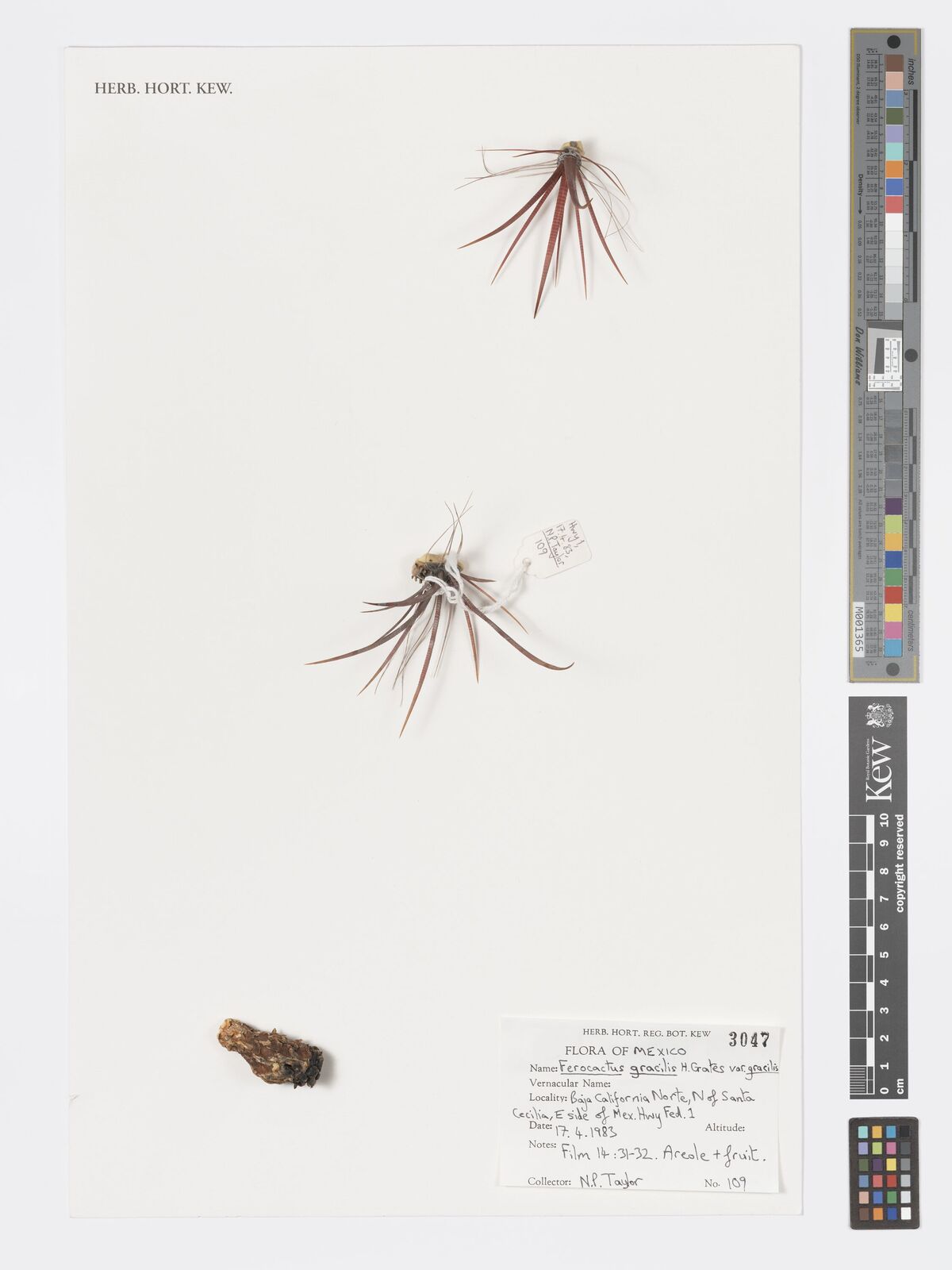 Reference image
Fire Barrel Cactus
Ferocactus gracilis, commonly known as the Fire Barrel Cactus, is an iconic, column-forming succulent in the Cactaceae family. Famous for its fiercely beautiful red spines and robust nature, it is a highly sought-after specimen for desert landscaping and container collections.
Belonging to the genus Ferocactus, which translates to "wild or fierce cactus", this species is characterized by heavy, prominent ribbing and formidable spines 1. The specific epithet "gracilis" means slender, referring to its somewhat narrower growth habit compared to other giant barrel cacti.
This cactus is native to the Baja California peninsula of Mexico 2. It thrives in gravelly, well-draining soils on dry, rocky slopes and desert plains, fully adapted to arid environments with intense solar radiation and minimal rainfall.
Initially globose, the stem becomes cylindrical with age, growing up to 3 meters tall. It features deep vertical ribs lined with clusters of bright red to reddish-brown spines, including a flattened central spine. In summer, mature plants produce striking funnel-shaped red flowers at the crown 1.
In cultivation, it requires minimal intervention. Providing full, direct sun is crucial to maintaining the brilliant red pigmentation of its spines. Watering should be done on a "soak and dry" basis, allowing the potting medium to dry out completely between sessions 2.
Overwatering is the leading cause of decline, quickly triggering root rot. Planting in heavy clay soil or keeping the plant in low-light conditions will lead to weak spine development and etioliated growth.
Requires full sun to maintain its signature bright red spine coloration.
Water only when soil is bone dry. Suspend watering in winter.
Needs highly porous, fast-draining mineral soil with high pumice content.
Features extremely sharp, rigid spines. Keep away from pets and children.
Very easy to care for if overwatering is strictly avoided.
Indigenous to the arid, rocky terrains and volcanic slopes of the Baja California Peninsula in Mexico.
