
Light
Full Sun
Requires full sun, ideally 6+ hours of direct sunlight daily to maintain its compact shape and robust spines.
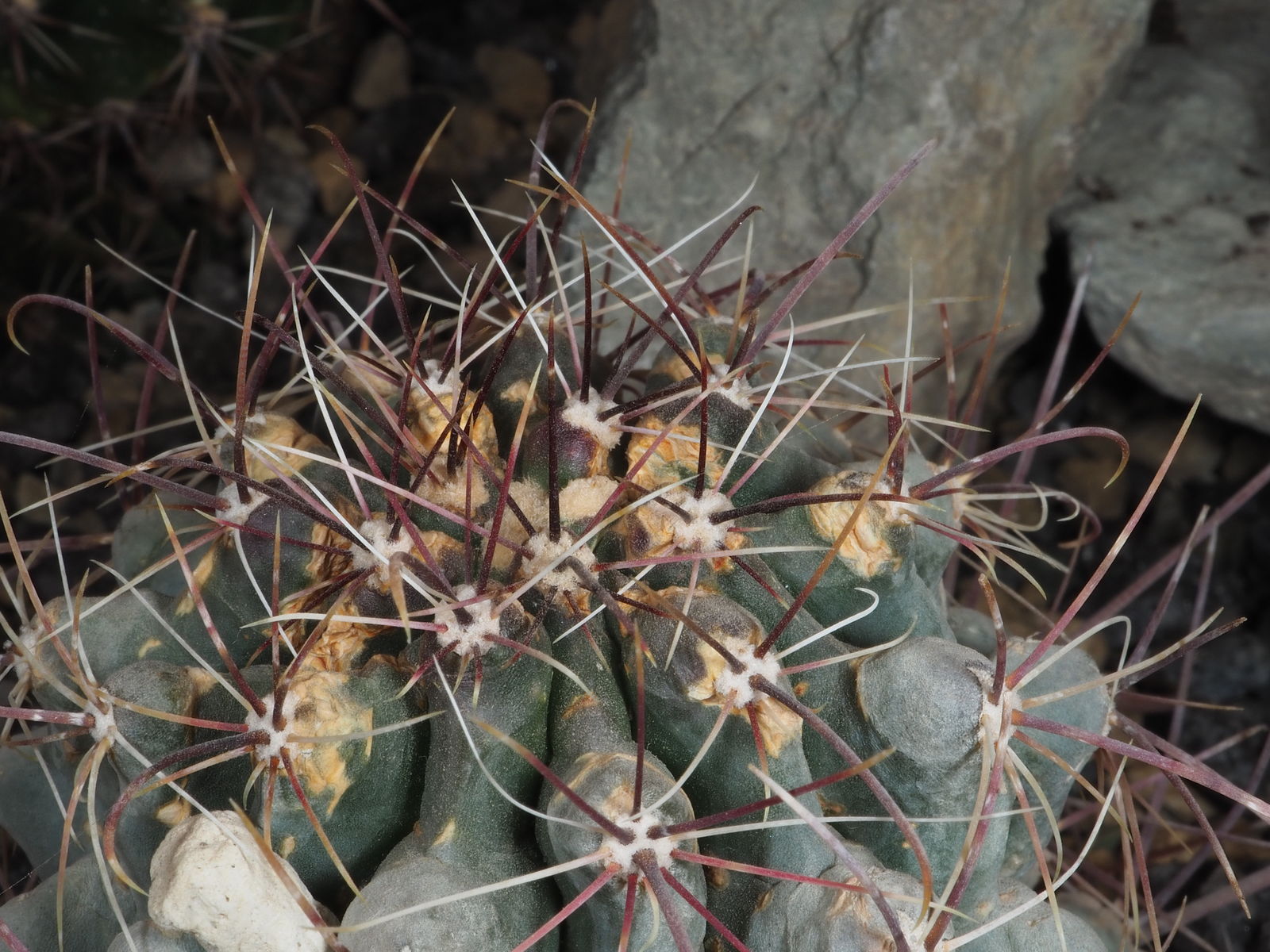 Reference image
Herrera's Barrel Cactus
Ferocactus herrerae, commonly known as Herrera's Barrel Cactus, is a massive, solitary barrel cactus belonging to the Cactaceae family. Celebrated for its formidable spination and imposing stature, this succulent subshrub is highly prized in xeriscaping and professional succulent collections globally 1.
Named in honor of the Mexican biologist Alfonso L. Herrera, this species belongs to the genus Ferocactus. While some taxonomists historically classified it as a subspecies or variety of Ferocactus wislizeni, modern databases such as POWO recognize it as a distinct and accepted species 12.
Native to northwestern Mexico (principally Sinaloa, Sonora, and Baja California Sur) and dry regions of Northern America, this cactus thrives in arid shrublands, coastal plains, and deciduous thorn forests. It is well-adapted to rocky, well-draining soils 2.
Initially globose, this species becomes columnar as it matures, reaching heights of up to 2 meters and a diameter of 40 cm. It features around 13 spiral ribs adorned with thick, greyish-brown to reddish spines. The central spines are distinctively flattened and slightly hooked. During summer, it produces funnel-shaped yellow flowers with reddish midribs 1.
This species demands full sun exposure and extremely porous soil. During the active spring and summer growth cycles, water thoroughly only when the substrate is completely dry. In winter, maintain dry conditions to prevent root rot and allow the plant to tolerate colder temperatures 2.
The most prevalent failure in cultivating this cactus is overwatering or utilizing dense, water-retaining soil, which invariably leads to basal rot. Sudden transitions to direct sunlight can also cause irreversible epidermal scarring 1.
Requires full sun, ideally 6+ hours of direct sunlight daily to maintain its compact shape and robust spines.
Strictly soak-and-dry. Keep completely dry in winter to prevent root and stem rot.
An inorganic, mineral-rich gritty soil with lots of pumice or perlite is essential.
Armed with very sharp, strong hooked spines; keep away from children and pets to avoid injuries.
Very easy for beginners, provided you do not overwater and offer plenty of direct sunlight.
Native to the coastal plains and dry shrublands of northwestern Mexico, particularly in the states of Sonora, Sinaloa, and the southern part of Baja California.
