
Light
Full Sun
Requires full sun, preferably at least 6 hours of direct sunlight daily, to maintain its compact shape and spine color.
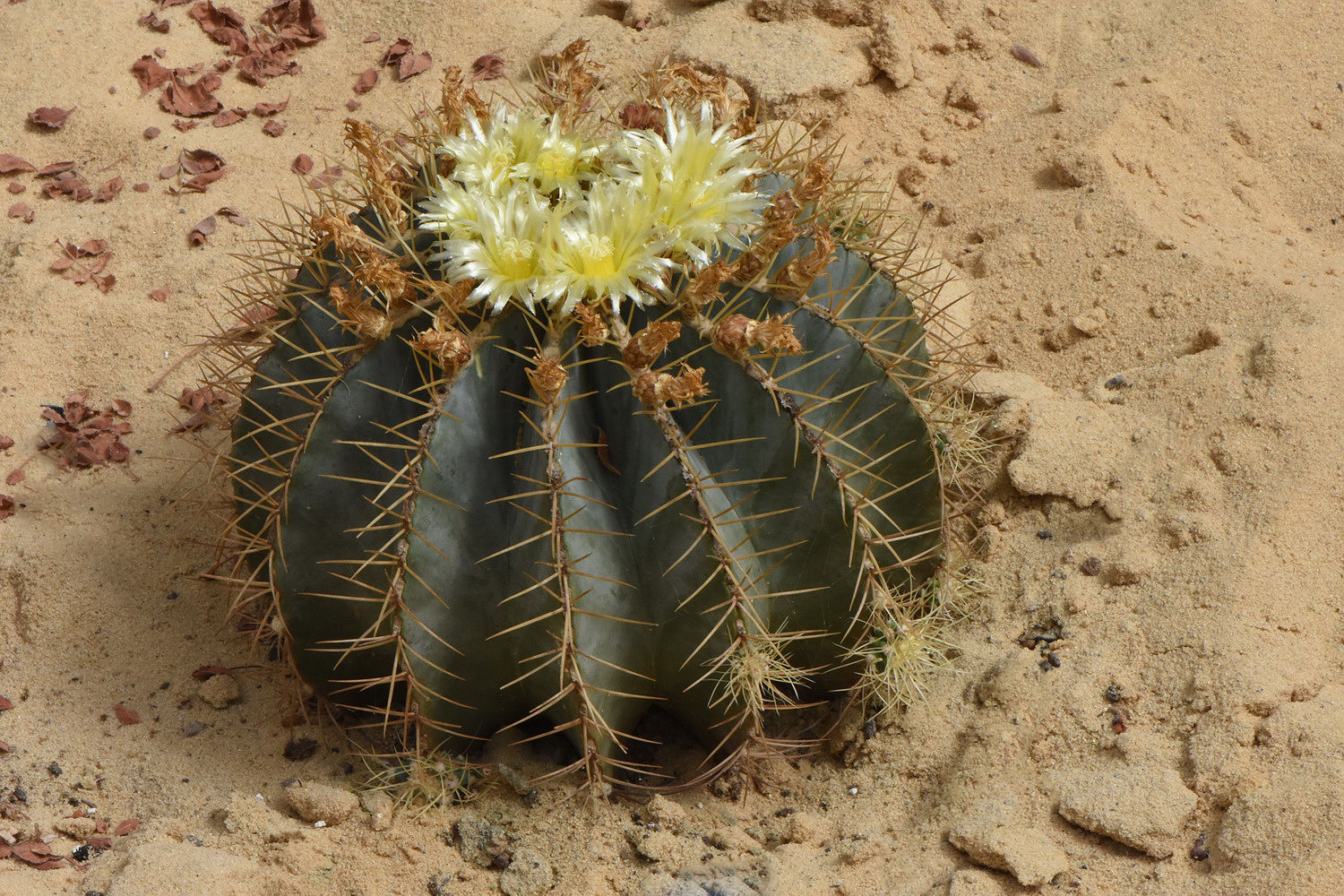 Reference image
Mexican Barrel Cactus
Ferocactus histrix is a robust, globose to cylindrical cactus belonging to the family Cactaceae, distinguished by its heavily ribbed stem and sharp, rigid spines 1. Commonly known as the Mexican Barrel Cactus, it is a classic representative of desert succulents.
Originally described by de Candolle, the species belongs to the genus Ferocactus, which translates to "fierce cactus" owing to their heavy armature 2. The specific epithet histrix is derived from the Latin word for "porcupine," directly referencing its dense, needle-like spine arrangement.
This species is endemic to central and northern Mexico, including states such as Aguascalientes, Guanajuato, Querétaro, San Luis Potosí, Jalisco, and Zacatecas 1. It thrives on limestone slopes, arid shrublands, and semi-desert environments at elevations between 1200 and 2200 meters.
The stem is initially globose, later becoming columnar with age, reaching up to 1 meter in height and 80 cm in diameter in the wild. It features 20-40 sharp, pronounced ribs. Areoles carry stout, yellowish to grayish spines that are relatively straight. In summer, mature specimens produce bell-shaped yellow flowers at the crown, followed by edible, fleshy fruits.
It requires full sun exposure and extremely well-draining mineral soil. During the active growing season (spring to autumn), water deeply only after the substrate has completely dried out. Keep virtually dry in winter to prevent root rot. It can tolerate short-term light frosts down to -4°C if kept bone dry.
Overwatering and high humidity during cold winter months are the primary causes of root and stem rot. Insufficient light exposure leads to etiolation, where the cactus loses its spherical shape and stretches weakly toward the light source.
Requires full sun, preferably at least 6 hours of direct sunlight daily, to maintain its compact shape and spine color.
Water thoroughly only when the soil is 100% dry; keep dry during winter dormancy.
Use a mineral-rich cactus mix with high proportions of pumice, gravel, and coarse sand.
Non-toxic, but the long, stiff, and sharp spines pose a physical injury hazard to pets and children.
An easy-care plant provided it receives maximum sunlight and is protected from overwatering.
Native to the dry highlands of Mexico, where it grows on limestone-rich rocky slopes and in semi-arid desert scrublands.
