
Light
Full Sun
Requires full sun, ideally 6+ hours of direct sunlight daily to maintain its golden spine color.
 Reference image
Johnston's Barrel Cactus
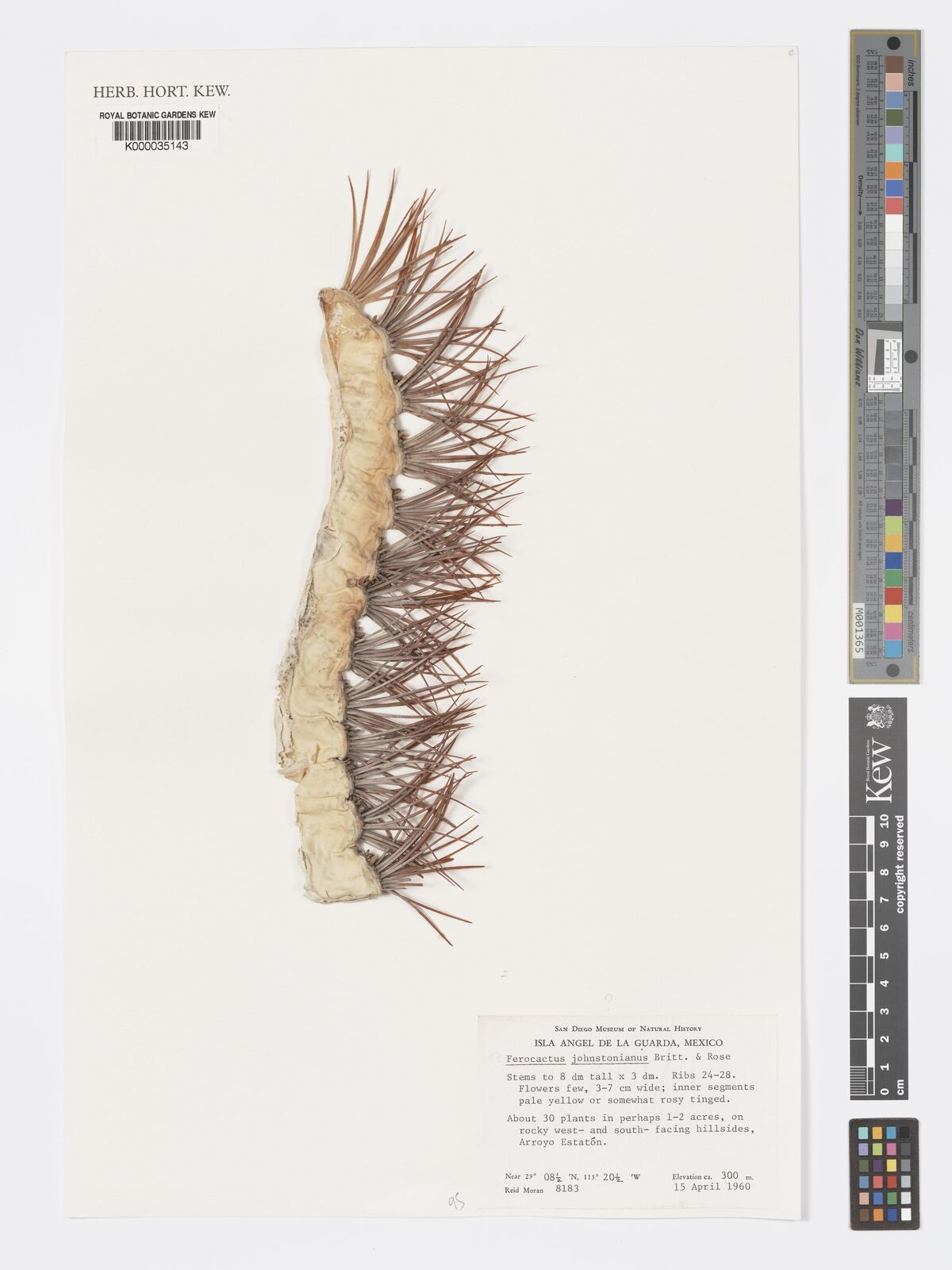
Ferocactus johnstonianus, commonly known as Johnston's Barrel Cactus, is a rare and striking succulent species belonging to the Cactaceae family. Renowned for its prominent cylindrical growth habit and bright golden-yellow spines, it is highly valued among collectors for its architectural beauty and extreme drought tolerance.
The species epithet honors Ivan Murray Johnston, an American botanist who collected plants extensively in Mexico during the early 20th century. Taxonomically situated within the genus Ferocactus 1, it shares close evolutionary lineages with other island-endemic barrel cacti, yet stands out due to its distinct spination and floral biology.
Ferocactus johnstonianus is strictly endemic to Angel de la Guarda Island in the Gulf of California, Mexico 2. It thrives in hyper-arid desert scrub, growing on steep, rocky volcanic slopes where it is exposed to harsh maritime winds and intense, unfiltered solar radiation.
This cactus begins as a solitary globose stem, gradually elongating into a column up to 1 meter in height and 35 cm in diameter. It features 24 to 35 pronounced, tuberculate ribs. The plant is densely covered with straight, subulate spines of a golden-yellow hue. Its funnel-shaped flowers, blooming at the apex in late spring, display yellow to yellowish-green petals.
In cultivation, replicating its desert habitat is essential. It demands a position in full sun and a highly mineral, fast-draining potting medium. Watering must be strictly seasonal, allowing the soil dry out completely between applications. During winter dormancy, it must be kept entirely dry.
The most prevalent issue is root rot resulting from waterlogged soil or excessive winter irrigation 3. Etioation—where the stem becomes abnormally elongated and pale—occurs when the plant does not receive sufficient direct sunlight.
Requires full sun, ideally 6+ hours of direct sunlight daily to maintain its golden spine color.
Water deeply in summer only after the soil is completely dry. Keep dry in winter.
Needs a very porous, mineral-rich soil mix with high content of pumice, grit, and sand.
Sharp, rigid spines can cause deep punctures. Keep away from pets and children.
Moderate. Easy if underwatered, but highly sensitive to overwatering and poor light.
Endemic to Angel de la Guarda Island in the Gulf of California, Mexico, where it grows on arid volcanic cliffs and slopes under intense sunlight.
