
Light
Full Sun
Requires at least 6-8 hours of direct, unfiltered sunlight daily.
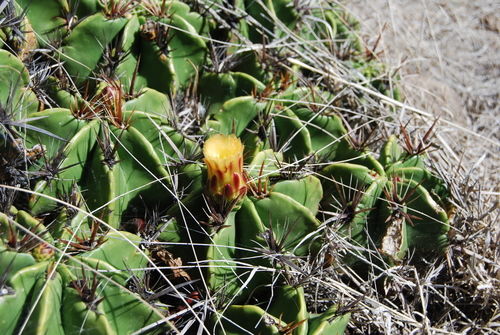 Reference image
Robust Barrel Cactus
Ferocactus robustus is one of the most remarkable clumping species within the family Cactaceae. Commonly known as the Robust Barrel Cactus, it is celebrated for its unique ability to form massive, multi-headed mounds 1.
The genus name Ferocactus is derived from the Latin word "ferox," meaning fierce or wild, referencing the plant's formidable spines. The specific epithet "robustus" denotes the plant's robust, heavily clustering growth habit 2.
Endemic to the Mexican states of Puebla and Oaxaca, Ferocactus robustus thrives in the arid matorral and rocky limestone slopes of the Tehuacán-Cuicatlán Valley 1. It occurs at elevations between 1000 and 2000 meters in semi-arid environments.
This species forms enormous cushions that can measure up to 5 meters in diameter and 1 meter in height, consisting of hundreds of individual stems. Individual stems are globular to cylindrical with well-defined ribs. The stiff, yellowish to brownish radial and central spines emerge from prominent woolly areoles. Bright yellow, funnel-shaped flowers appear in late summer.
In cultivation, Ferocactus robustus requires direct, full sun and exceptionally well-draining, mineral-based soil. Water should be applied thoroughly during the active growing season only after the substrate has dried completely. Winter watering should be virtually suspended.
The most prevalent cultivation error is overwatering combined with poor ventilation, which rapidly leads to root and stem rot 2. Insufficient sunlight results in etiolation, causing the stems to lose their natural robust shape and weakening the spine development.
Requires at least 6-8 hours of direct, unfiltered sunlight daily.
Let soil dry out 100% between waterings. Keep dry in winter.
Prefers a highly mineral substrate with plenty of pumice and grit.
Heavy, rigid spines pose a physical hazard; handle with thick leather gloves.
Extremely low-maintenance as long as you avoid overwatering.
Native to the dry valley beds and steep limestone slopes of Puebla and Oaxaca in southern Mexico.
