
Light
Full Sun
Requires full sun, ideally 6 to 8 hours of direct sunlight daily to maintain strong spines.
 Reference image
Townsend's Barrel Cactus
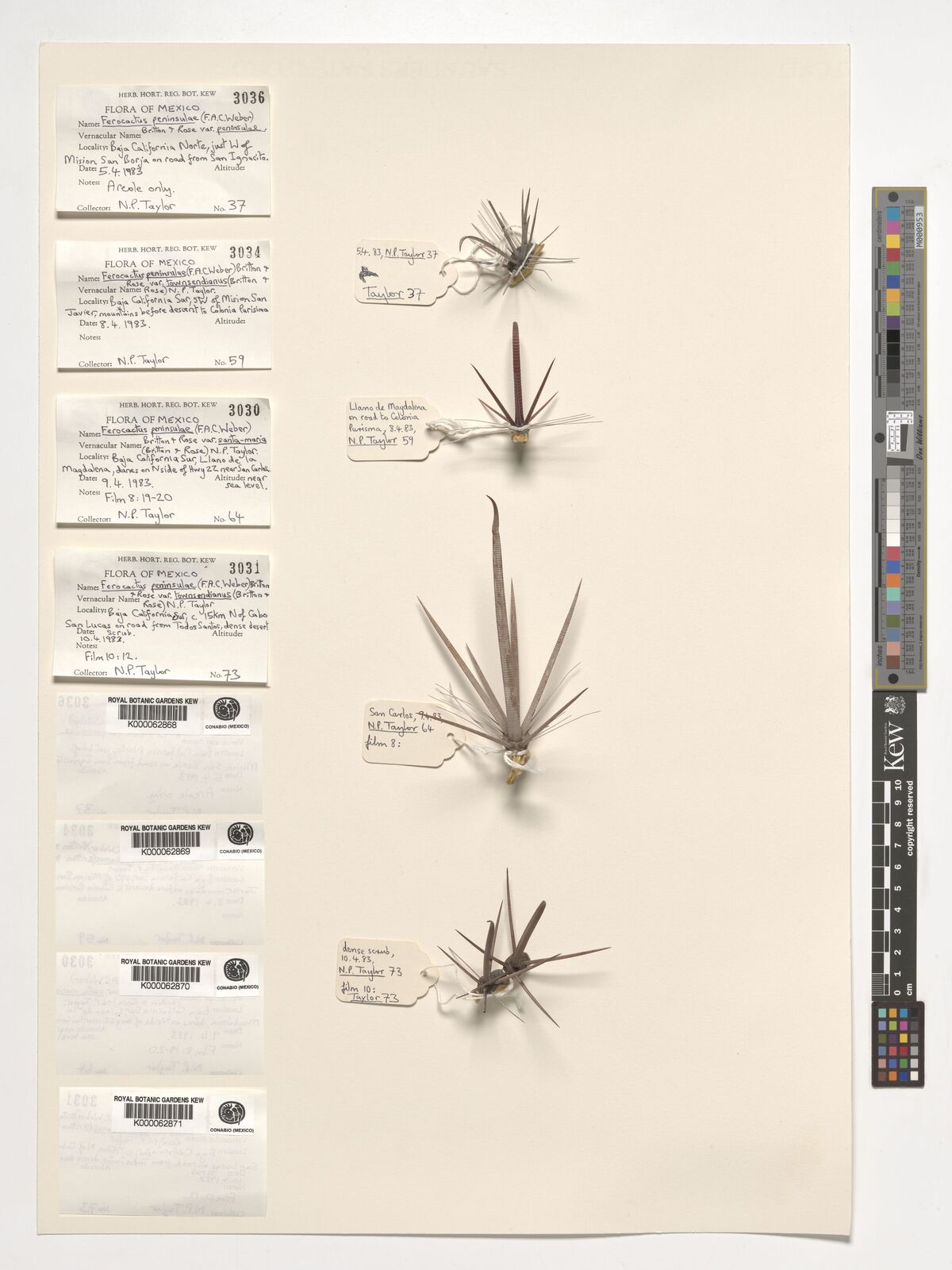
Ferocactus townsendianus is a distinctive and highly ornamental member of the Cactaceae family. Characterized by its solitary stem, stout spine structure, and prominent ribs, this succulent subshrub is highly adapted to extreme arid conditions 1. It is widely favored in succulent collections for its geometric symmetry and colorful, fierce spination.
Originally described by Britton and Rose, the species belongs to the genus Ferocactus (meaning wild or fierce cactus). The specific epithet honors C. H. Townsend, a naturalist who conducted extensive research in the region 2. It is closely allied with the Ferocactus peninsulae complex, sometimes treated as a subspecies within that group.
Native to Mexico, specifically the Baja California Peninsula and adjacent gulf islands. It thrives in arid desert flats, rocky slopes, and dry shrublands (matorral) 1. The species is well-adapted to high solar radiation and low atmospheric humidity near coastal regions.
The stem is initially globose, becoming cylindrical with age, reaching up to 40-50 cm in height. It features deep, wavy ribs lined with prominent areoles. The spines are heavy, reddish-brown to grayish, with a central spine that is characteristically hooked. Funnel-shaped flowers in shades of yellow, orange, or red with darker midstripes appear at the crown in summer.
This species demands full direct sun for optimal spine development and growth. Watering should follow a strict 'soak and dry' method, allowing the substrate to dry completely. During the winter dormancy, watering must be suspended almost entirely. Highly porous, mineral-heavy soil mixes are essential.
The most prevalent error is overwatering in winter or using water-retaining soils, which rapidly leads to root rot. Insufficient light causes etiolation, wherein the cactus loses its compact globose form and stretches towards light sources.
Requires full sun, ideally 6 to 8 hours of direct sunlight daily to maintain strong spines.
Water deeply only when the soil is completely dry. Keep dry in winter.
Requires a highly porous, gritty mineral mix containing pumice, sand, and perlite.
Features extremely sharp, hooked spines. Place out of reach of children and pets.
Moderate. Easy if overwatering is avoided, but sensitive to poorly draining soils.
This cactus is native to the dry coastal cliffs, rocky slopes, and desert scrublands of the Baja California Peninsula and its surrounding islands in Mexico, growing in conditions of high light and low annual rainfall.
