
Light
Full Sun
Full, direct sun is required. Insufficient light leads to pale, stretched growth.
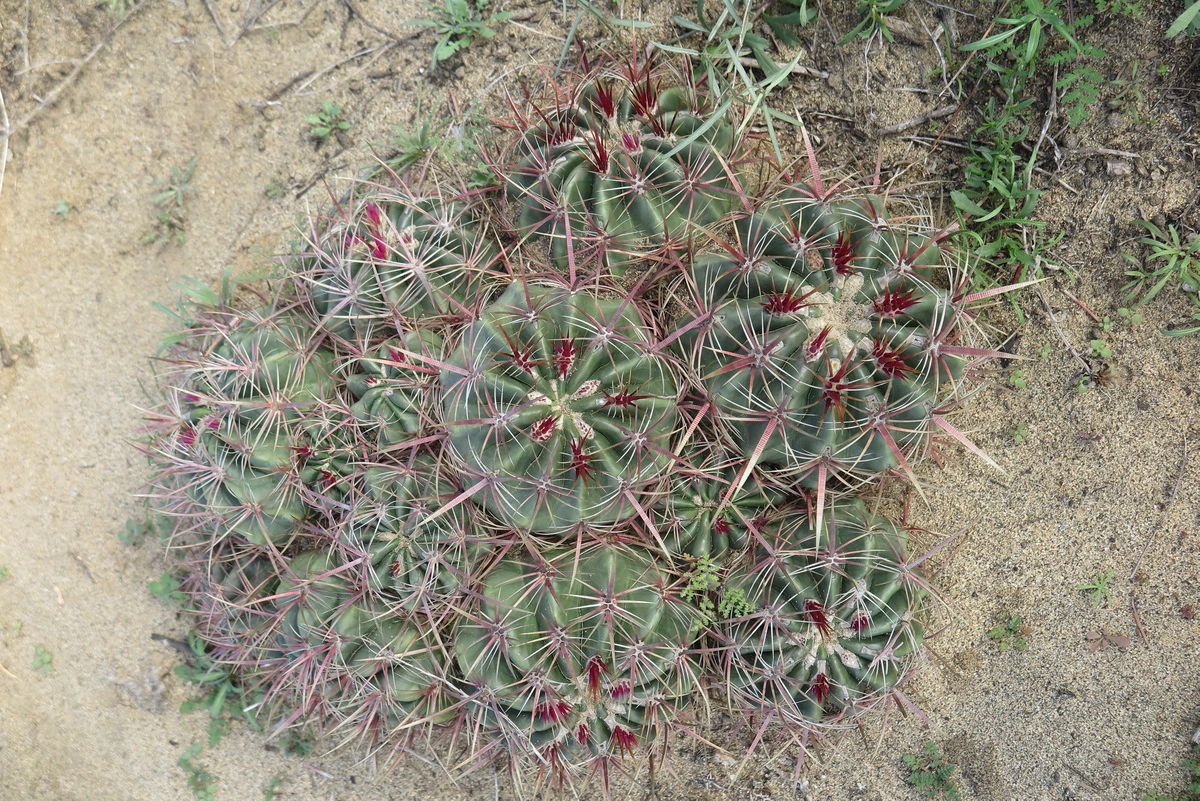 Reference image
San Diego Barrel Cactus
Ferocactus viridescens, commonly known as the San Diego barrel cactus or coast barrel cactus, is a globose to cylindrical perennial succulent belonging to the Cactaceae family. Highly adapted to maritime-influenced desert habitats, it is prized for its architectural form, dense spines, and chartreuse-colored flowers.
Belonging to the genus Ferocactus, this species was formally described by George Engelmann in 1845. The specific epithet "viridescens" translates from Latin to mean "becoming green" or "greenish," referencing the plant's characteristic skin tone and flower coloration 1.
This species has a restricted geographic range along the Pacific coast of North America. It is native to southwestern California (specifically San Diego County) and northwestern Baja California, Mexico 2. It grows primarily on dry, stony hillsides, coastal sage scrub, and coastal bluffs, benefitling from maritime fog moisture.
Initially globose and somewhat flattened, the stem elongates into a cylindrical form with age, reaching up to 30 cm in height and 35 cm in diameter. It features 13 to 21 prominent ribs lined with fuzzy areoles. Spines are robust, heavily ribbed, initially reddish or yellow-green, and fade to grey. It produces green-yellow, bell-shaped flowers in late spring.
Ferocactus viridescens thrives in full sun and fast-draining, mineral-rich soil. It is highly drought-tolerant and requires minimum winter temperatures above freezing, though dry specimens can withstand brief light frosts down to -3°C 1.
Overwatering and placing the cactus in dense, organic-rich soil that retains moisture are the primary causes of root rot. Lack of adequate direct sunlight leads to etiolation.
Full, direct sun is required. Insufficient light leads to pale, stretched growth.
Drench thoroughly only when soil is completely dry. Keep dry in winter.
Mineral-rich, gritty potting mix with excellent drainage (pumice, sand, perlite).
Non-toxic, but the rigid, curved spines can cause painful physical injuries.
Very easy to grow if kept in bright sun and never allowed to sit in water.
Native to coastal hills, bluffs, and chaparral areas of extreme southern California and northern Baja California, growing in rocky, well-draining soils.
