
Light
Bright Indirect Light
Requires plenty of bright, filtered sunlight; protect from harsh afternoon sun in mid-summer.
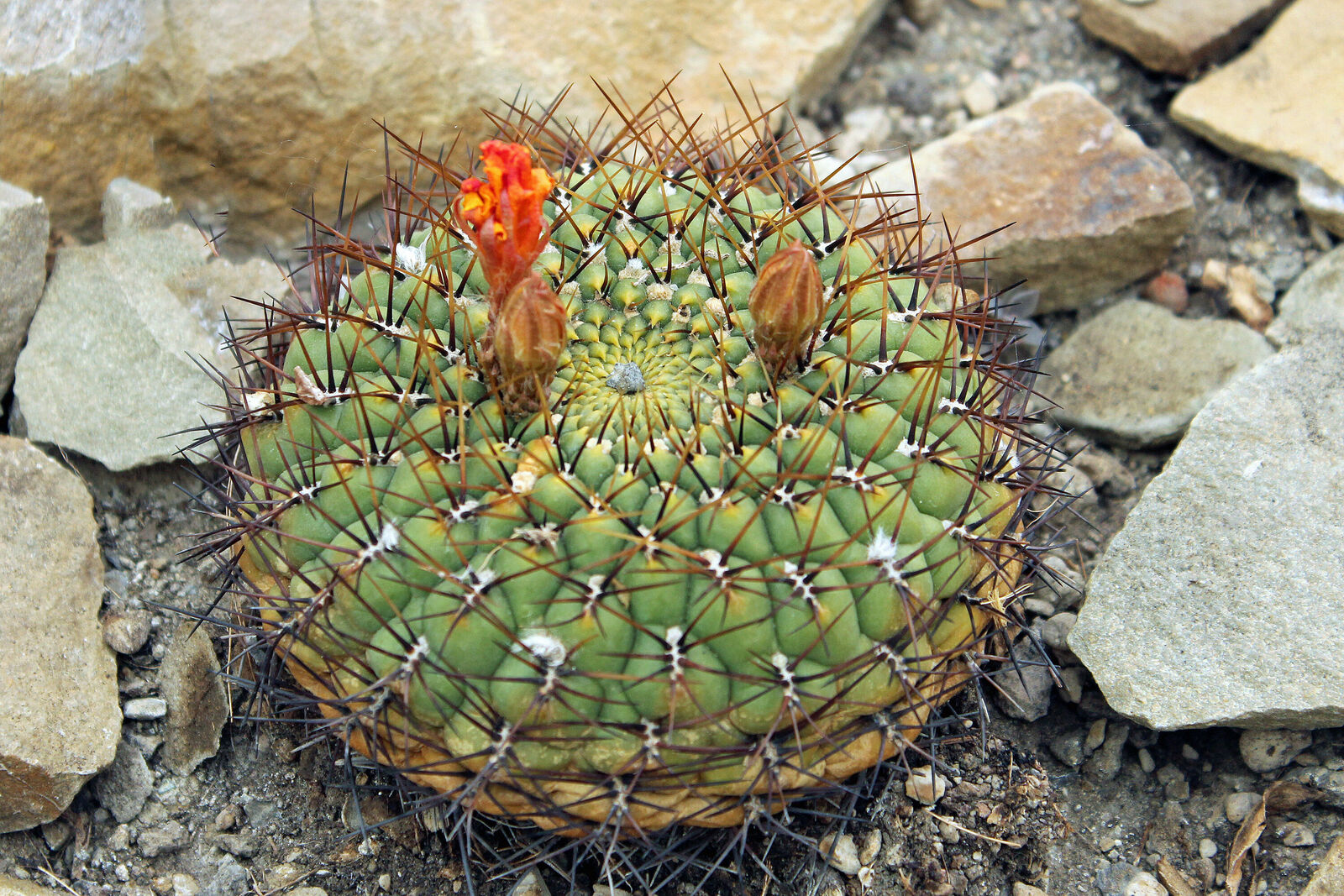 Reference image
Golden-Flowered Matucana
Matucana aureiflora is a highly prized, solitary globose cactus endemic to the high-altitude regions of Peru. Due to its restricted natural range and habitat degradation, it is classified as Endangered (EN) on the IUCN Red List. It is celebrated among succulent enthusiasts for its compact, flattened body and brilliant golden-yellow blossoms 1.
The species was first described by the renowned botanist Friedrich Ritter. The genus name 'Matucana' honors the Peruvian town of Matucana, near where the first species of the genus were found. The specific epithet 'aureiflora' derives from Latin, meaning 'golden-flowered', pointing directly to its diagnostic, radiant yellow inflorescence 2.
Matucana aureiflora is restricted to the Cajamarca region in Peru, occurring at elevations between 2,800 and 3,000 meters above sea level. It thrives in montane tropical biomes, clinging to steep, rocky slopes and grassy ledges where rainwater drains instantly away from its roots 1.
The plant has a depressed-globose, dark green stem that can reach up to 13 cm in diameter, divided into 11 to 27 low, tuberculate ribs. Spines are stout, pectinately arranged, and vary from yellow to brownish-gold. Its most remarkable feature is the diurnal, funnelform golden-yellow flowers that appear at the crown in spring and summer.
In cultivation, this species requires a very porous, mineral-based potting medium to prevent root rot. It demands bright, indirect sunlight and good air circulation. Water thoroughly during the active growing season but let the soil dry out completely between waterings. Keep absolutely dry in winter 2.
Overwatering is the primary cause of failure, especially during cold winter months, which quickly leads to lethal root rot. Additionally, placing the plant in a poorly ventilated area or exposing it to harsh, unfiltered midday summer sun without prior acclimation can result in severe epidermal scorching.
Requires plenty of bright, filtered sunlight; protect from harsh afternoon sun in mid-summer.
Water only when the substrate is entirely dry during spring and summer; keep dry during winter dormancy.
Requires a porous mineral substrate rich in pumice, gravel, and sand with minimal organic matter.
Non-toxic, but features sharp, curved spines that require careful handling and placement.
Moderate difficulty due to strict drainage and watering requirements to prevent root rot.
Native to the high Andes of Cajamarca, Peru, this plant occupies rocky, mountainous slopes with sharp drainage and high light intensity, adapted to cool nights and dry alpine conditions.
