
Light
Bright Indirect Light
Requires abundant bright, filtered light; protect from scorching midday summer sun.
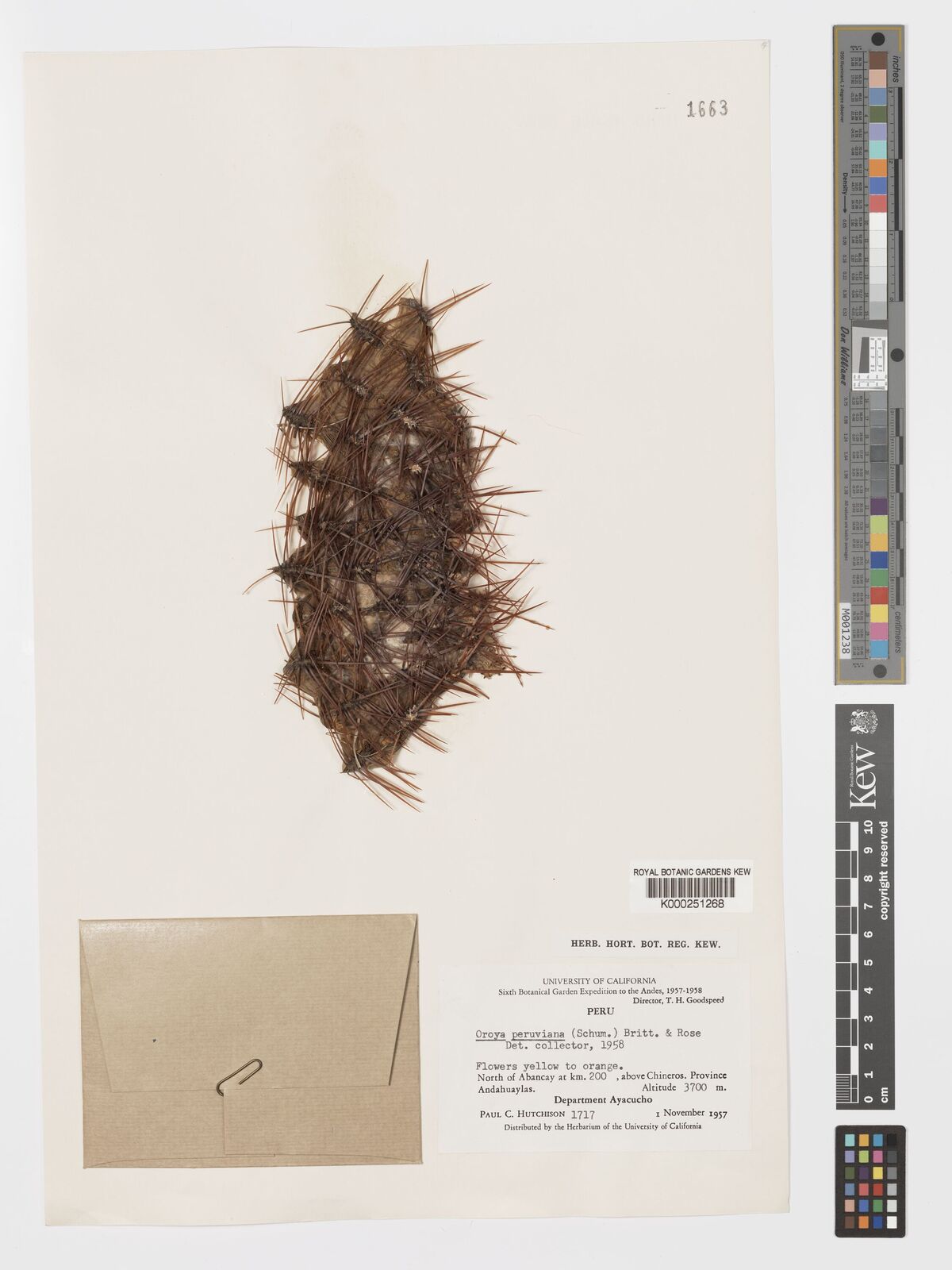 Reference image
Peruvian Matucana
Matucana peruviana is a perennial, succulent subshrub belonging to the Cactaceae family, native to the high-altitude arid regions of Peru 1. Known for its globose growth habit and spectacularly bright, zygomorphic flowers, it is highly valued by succulent collectors and rock garden enthusiasts worldwide.
The genus Matucana is named after the town of Matucana, located near Lima, Peru, where the first specimens were documented. Matucana peruviana is closely related to the Matucana haynei complex, and taxonomists sometimes debate its status as a distinct species or a subspecies, though major databases like POWO recognize it individually 1.
This species is endemic to western South America, specifically the Andean slopes of Peru, growing at elevations of 2,000 to 3,000 meters 2. It thrives in cracks of steep cliffs and gravelly slopes within desert or dry shrubland biomes, surviving on minimal organic matter.
It features a solitary or slowly clustering globose stem that elongates slightly with age. The ribs are spiraled and tuberculate, adorned with clusters of bristly, brownish-yellow or grey spines. The flowers are narrow, tube-like, and showcase vivid shades of red, orange, or deep pink, blooming from the apex in late spring.
In cultivation, Matucana peruviana requires a great deal of bright, indirect sunlight or filtered morning sun. A highly porous mineral substrate is essential to mimic its steep, fast-draining natural habitat. Water thoroughly only when the soil has dried out completely.
Overwatering is the primary cause of failure. Inadequate ventilation combined with high humidity easily triggers stem rot. Keeping the plant in standard organic potting soil instead of a coarse mineral mix will eventually suffocate the root system.
Requires abundant bright, filtered light; protect from scorching midday summer sun.
Water thoroughly once the substrate is dry in spring/summer; keep dry in winter.
Gritty, low-organic mineral mix with high amounts of pumice, lava rock, and coarse sand.
The plant possesses sharp, needle-like spines; keep away from children and pets.
Moderate. It is easy to care for as long as overwatering is avoided.
Native to the Andean heights of Peru, where it grows in cracks of rocky cliffs and steep mountain slopes amidst arid scrublands and high-altitude deserts.
