
Light
Bright Indirect Light
Prefers bright, indirect sunlight or filtered sun. Protect from scorching midday rays.
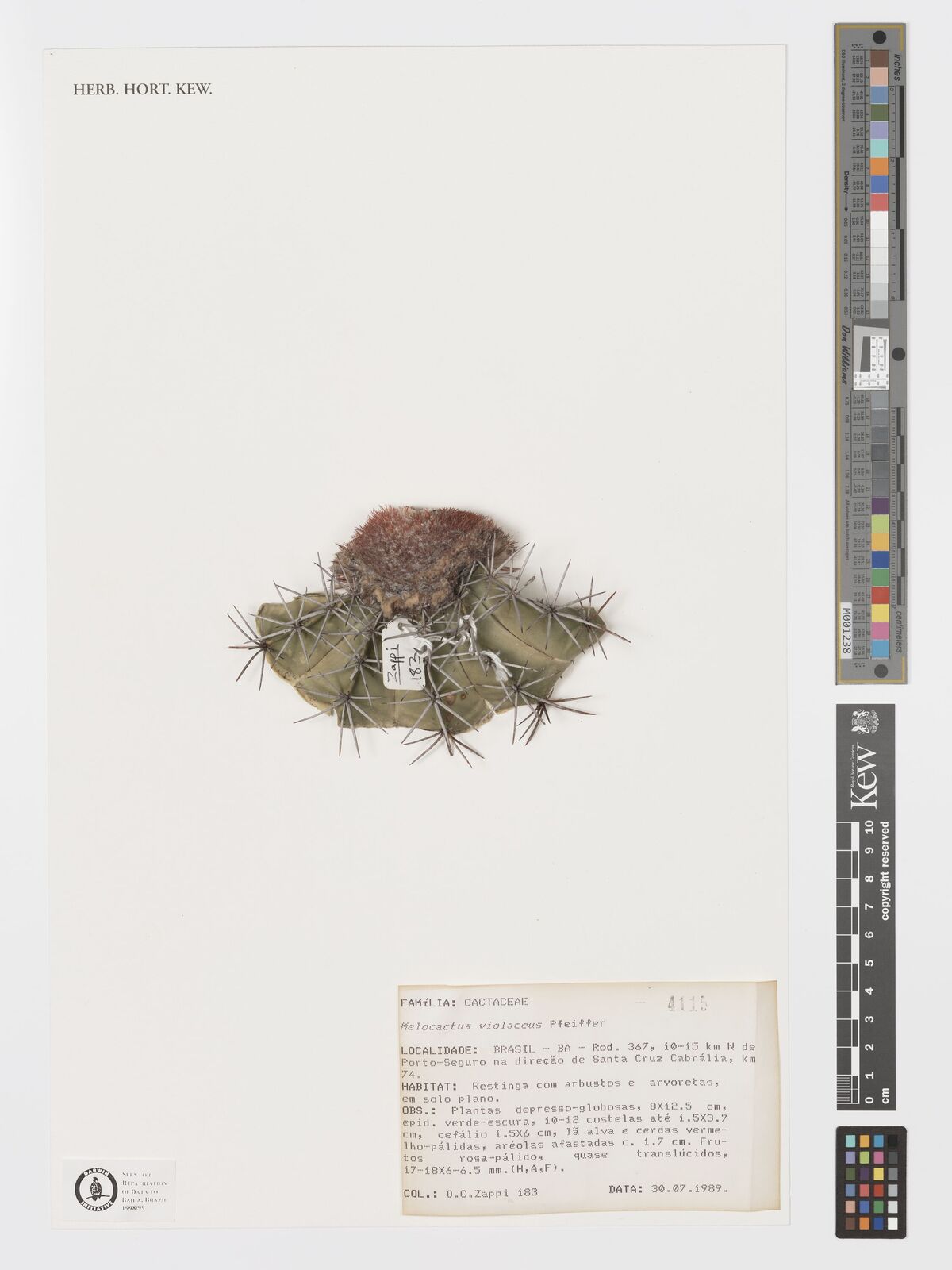 Reference image
Melon Cactus
Melocactus violaceus, belonging to the Cactaceae family, is a slow-growing, highly distinct succulent subshrub renowned for its characteristic pink-to-purple cephalium. Unlike standard desert cacti, it alters its growth form entirely upon reaching maturity, producing a terminal woolly structure dedicated solely to flowering and fruiting 1.
Originally described by the German botanist Pfeiffer, this species is one of the smallest representatives of the genus Melocactus. The specific epithet violaceus refers to the bright violet-pink hue of its fruits and flowers that emerge from the mature cephalium 2.
This species is endemic to the eastern coastal regions of Brazil, spanning states such as Bahia, Espírito Santo, Minas Gerais, Rio de Janeiro, and Sergipe 1. It is primarily found in coastal sand dunes ('restinga' vegetation) and dry tropical shrublands, growing almost exclusively on poor, acidic quartzitic sands near sea level 3.
The stem is globose to depressed-globose, deep green, typically measuring 5 to 15 cm in diameter with 9 to 15 distinct, acute ribs. Areoles bear short, slightly recurved spines. Upon reaching maturity (usually around 6 to 10 years of age), the vegetative growth ceases, and it develops a cylindrical cephalium coated with dense white wool and pinkish-bristles 2.
Melocactus violaceus requires more tropical conditions than typical desert cacti. During the active growing season, it should be watered regularly, allowing the soil to dry slightly but not completely. Unlike other cacti, it cannot tolerate prolonged dry winter periods and requires a minimum temperature above 10°C in a well-drained, sandy, and slightly acidic medium 3.
The most prevalent error is subjecting the plant to prolonged winter drought or near-freezing temperatures. Cold draft exposure combined with dry soil leads to rapid root loss, from which Melocactus rarely recovers. Conversely, waterlogged conditions trigger immediate basal rot.
Prefers bright, indirect sunlight or filtered sun. Protect from scorching midday rays.
Water thoroughly in summer when soil dries; keep slightly damp in winter.
Highly porous, slightly acidic soil containing quartz sand and organic matter.
Sharp spines can cause injury; keep away from curious pets and children.
Moderate difficulty due to strict temperature limits and specific winter watering needs.
Native to the restinga sandy dunes and dry tropical shrublands along the eastern coast of Brazil, where it thrives in pure quartzite sands under warm, humid sea breezes.
