
Light
Full Sun
Requires full, direct sun to maintain its signature dense and bright golden spine coloration.
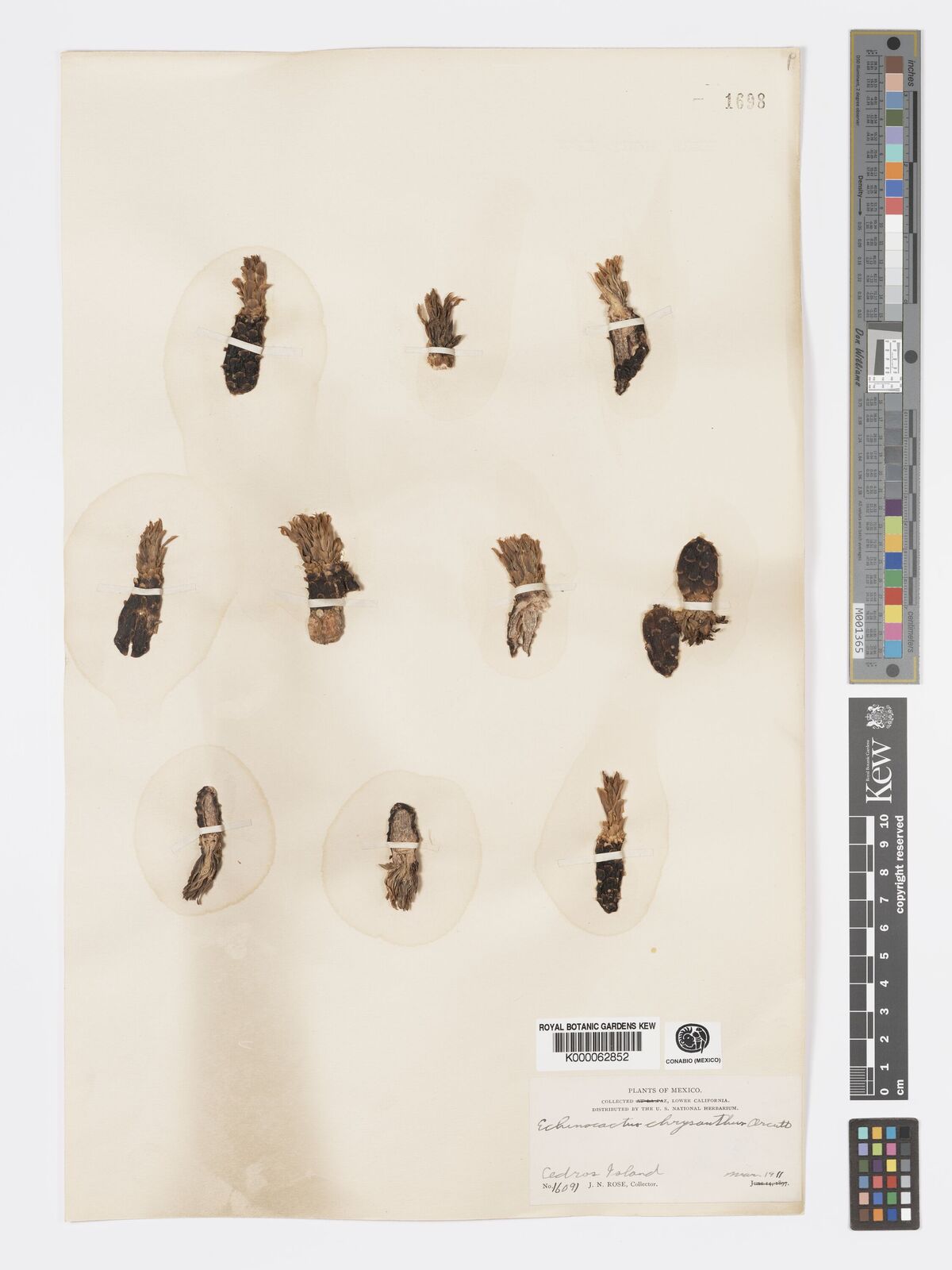 Reference image
Golden-Spined Barrel Cactus
Ferocactus chrysacanthus is a slow-growing, highly ornamental globose to cylindrical cactus belonging to the family Cactaceae. Famed for its dense, golden-yellow armor of heavy spines, it is a highly sought-after species among succulent and cacti enthusiasts 1.
The species was classified under the genus Ferocactus, which comprises the robust barrel cacti of North America. The specific epithet 'chrysacanthus' derives from the Ancient Greek words 'chrysos' (gold) and 'akantha' (spine), directly referencing its brilliant yellow spination 2.
This cactus is endemic to Mexico, specifically restricted to Cedros Island and the San Benito Islands off the west coast of Baja California. It thrives on steep, rocky coastal cliffs and windswept desert slopes, highly adapted to maritime fogs and arid conditions 1.
Typically solitary, it begins as a globose stem and matures into a cylindrical body reaching up to 1 meter in height. It features around 21 prominent ribs covered in dense clusters of rigid, ringed, and slightly curved central spines that range from pale yellow to deep golden-red. The funnel-shaped flowers appear at the crown in summer, bearing yellow to orange hues 2.
In cultivation, it requires full sun exposure and an exceptionally porous mineral substrate to prevent water retention. Water thoroughly only when the growing medium is completely dry, and suspend watering almost entirely during the winter dormancy. It exhibits moderate frost tolerance if kept absolutely dry 1.
Overwatering and poor soil drainage are the primary causes of root rot. Lack of sufficient direct sunlight leads to etiolation, loss of its compact shape, and duller, weaker spine development.
Requires full, direct sun to maintain its signature dense and bright golden spine coloration.
Water strictly on a 'soak and dry' method. Keep dry in winter to prevent root rot.
Thrives in a highly porous, inorganic mix composed of pumice, gravel, and coarse sand.
Features extremely sharp, rigid spines. Handle with extreme care and keep out of reach of pets.
An easy-care plant for experienced collectors, provided overwatering is strictly avoided.
Endemic to the rugged coastal slopes of Cedros and San Benito Islands in Baja California, Mexico, where it lives in rocky soils influenced by coastal air currents and periodic sea fogs.
