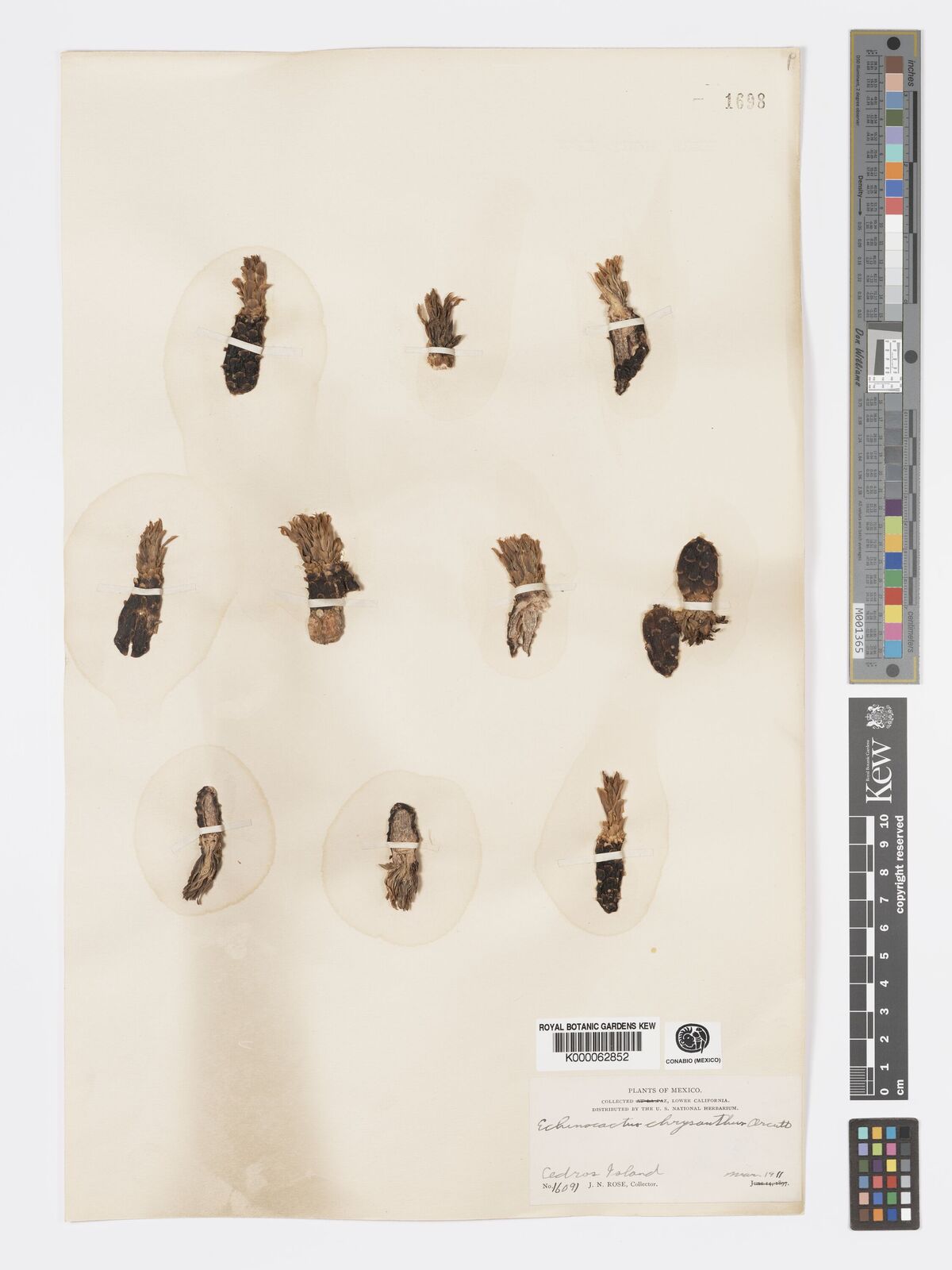
Species

Ferocactus chrysacanthus

Ferocactus chrysacanthus

Ferocactus chrysacanthus

Ferocactus chrysacanthus (Orcutt) Britton & Rose is treated as an accepted taxon in Plants of the World Online.1

The current source-backed classification places it in Cactaceae within Ferocactus.12

Its recorded native range/source remark is MXNSO, MXNBS, MEXICO, MXN, MXNSI, NORTHERNAMERICA, MXN_BC; NW. Mexico (I. Cedros, W. I. San Benito).1

POWO records the plant context as succulent subshrub, desert or dry shrubland.1

This is a source-populated draft intended for later Kaktus Doktoru editorial rewriting; care advice and morphology should be reviewed before publication.

References

  1. Plants of the World Online. "Ferocactus chrysacanthus (Orcutt) Britton & Rose". Royal Botanic Gardens, Kew. Accessed: 2026-06-10. https://powo.science.kew.org/taxon/urn:lsid:ipni.org:names:103613-2
  2. GBIF Secretariat. "Ferocactus chrysacanthus". GBIF Backbone Taxonomy. Accessed: 2026-06-10. https://www.gbif.org/species/7284587

Plants In This Group

Ferocactus chrysacanthus

Ferocactus chrysacanthus

Ferocactus chrysacanthus

Ferocactus chrysacanthus is a slow-growing, highly ornamental globose to cylindrical cactus belonging to the family Cactaceae. Famed for its dense, golden-yellow armor of heavy spines, it is a highly sought-after species among succulent and cacti enthusiasts 1.

Classification and Nomenclature

The species was classified under the genus Ferocactus, which comprises the robust barrel cacti of North America. The specific epithet 'chrysacanthus' derives from the Ancient Greek words 'chrysos' (gold) and 'akantha' (spine), directly referencing its brilliant yellow spination 2.

Natural Distribution and Habitat

This cactus is endemic to Mexico, specifically restricted to Cedros Island and the San Benito Islands off the west coast of Baja California. It thrives on steep, rocky coastal cliffs and windswept desert slopes, highly adapted to maritime fogs and arid conditions 1.

Appearance

Typically solitary, it begins as a globose stem and matures into a cylindrical body reaching up to 1 meter in height. It features around 21 prominent ribs covered in dense clusters of rigid, ringed, and slightly curved central spines that range from pale yellow to deep golden-red. The funnel-shaped flowers appear at the crown in summer, bearing yellow to orange hues 2.

Cultivation and Care

In cultivation, it requires full sun exposure and an exceptionally porous mineral substrate to prevent water retention. Water thoroughly only when the growing medium is completely dry, and suspend watering almost entirely during the winter dormancy. It exhibits moderate frost tolerance if kept absolutely dry 1.

Common Cultivation Errors

Overwatering and poor soil drainage are the primary causes of root rot. Lack of sufficient direct sunlight leads to etiolation, loss of its compact shape, and duller, weaker spine development.

References

  1. Plants of the World Online (POWO), Royal Botanic Gardens, Kew.
  2. IUCN Red List of Threatened Species, Ferocactus chrysacanthus Conservation Status.

Frequently Asked Questions

What is Ferocactus chrysacanthus?
Ferocactus chrysacanthus is a species-level taxonomy entry identified by the scientific name Ferocactus chrysacanthus.
Which rank is Ferocactus chrysacanthus?
Ferocactus chrysacanthus is shown as a species in our botanical dictionary.
Which groups sit below Ferocactus chrysacanthus?
No lower taxonomy landing pages are currently shown for Ferocactus chrysacanthus.
Are there plants related to Ferocactus chrysacanthus?
Yes. Related dictionary entries include Ferocactus chrysacanthus.
Is this taxonomy page a care guide?
No. This page explains scientific classification; light, watering, and safety guidance belongs on individual plant pages.
Is Ferocactus chrysacanthus a product category?
No. This is a scientific taxonomy record. Product categories are organized separately around customer search intent.
Why is the Latin name shown?
The Latin scientific name reduces ambiguity between common names across languages and regions.
Where can I see the parent ranks?
The taxonomy card shows the parent ranks of Ferocactus chrysacanthus inside the scientific hierarchy.
Can this page change over time?
Yes. Taxonomy and dictionary content can be updated as botanical data, greenhouse observations, and collection records improve.
Why is this different from a plant detail page?
This page explains a classification node. Individual plant pages contain care notes, collection links, and practical growing information.